Reference articles on history, science, culture and more
Encyclopedia

Diagonal functor

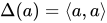
In category theory, a branch of mathematics, the diagonal functor {\mathcal {C}}\rightarrow {\mathcal {C}}\times {\mathcal {C}} is given by \Delta (a)=\langle a,a\rangle, which maps objects as well as morphisms. This functor can be employed to give a succinct alternate description of the product of objects within the category {\mathcal {C}}: a product a\times b is a universal arrow from \Delta to \langle a,b\rangle. The arrow comprises the projection maps.

More generally, given a small index category {\mathcal {J}}, one may construct the functor category {\mathcal {C}}^{\mathcal {J}}, the objects of which are called diagrams. For each object a in {\mathcal {C}}, there is a constant diagram \Delta _{a}:{\mathcal {J}}\to {\mathcal {C}} that maps every object in {\mathcal {J}} to a and every morphism in {\mathcal {J}} to 1_{a}. The diagonal functor \Delta :{\mathcal {C}}\rightarrow {\mathcal {C}}^{\mathcal {J}} assigns to each object a of {\mathcal {C}} the diagram \Delta _{a}, and to each morphism f:a\rightarrow b in {\mathcal {C}} the natural transformation \eta in {\mathcal {C}}^{\mathcal {J}} (given for every object j of {\mathcal {J}} by \eta _{j}=f). Thus, for example, in the case that {\mathcal {J}} is a discrete category with two objects, the diagonal functor {\mathcal {C}}\rightarrow {\mathcal {C}}\times {\mathcal {C}} is recovered.

Diagonal functors provide a way to define limits and colimits of diagrams. Given a diagram {\mathcal {F}}:{\mathcal {J}}\rightarrow {\mathcal {C}}, a natural transformation \Delta _{a}\to {\mathcal {F}} (for some object a of {\mathcal {C}}) is called a cone for {\mathcal {F}}. These cones and their factorizations correspond precisely to the objects and morphisms of the comma category (\Delta \downarrow {\mathcal {F}}), and a limit of {\mathcal {F}} is a terminal object in (\Delta \downarrow {\mathcal {F}}), i.e., a universal arrow \Delta \rightarrow {\mathcal {F}}. Dually, a colimit of {\mathcal {F}} is an initial object in the comma category ({\mathcal {F}}\downarrow \Delta ), i.e., a universal arrow {\mathcal {F}}\rightarrow \Delta.

If every functor from {\mathcal {J}} to {\mathcal {C}} has a limit (which will be the case if {\mathcal {C}} is complete), then the operation of taking limits is itself a functor from {\mathcal {C}}^{\mathcal {J}} to {\mathcal {C}}. The limit functor is the right-adjoint of the diagonal functor. Similarly, the colimit functor (which exists if the category is cocomplete) is the left-adjoint of the diagonal functor. For example, the diagonal functor {\mathcal {C}}\rightarrow {\mathcal {C}}\times {\mathcal {C}} described above is the left-adjoint of the binary product functor and the right-adjoint of the binary coproduct functor.

Watch videos about Diagonal functorExplainers and documentaries on YouTube (opens in a new tab)

Sources and credits

This article is adapted from the Wikipedia article Diagonal functor, written by its contributors and licensed under CC BY-SA 4.0. Fathomly has changed the layout, removed citation markers, navigation and maintenance notices, and adjusted punctuation. This adapted version is shared under the same license. For references, see the original article.

Fathomly is not affiliated with or endorsed by the Wikimedia Foundation. Spotted a problem? Tell us.