Treewidth
Number denoting a graph's closeness to a tree
In graph theory, the treewidth of an undirected graph is an integer number which specifies, informally, how far the graph is from being a tree. The smallest treewidth is 1; the graphs with treewidth 1 are exactly the trees and the forests. An example of graphs with treewidth at most 2 are the series-parallel graphs. The maximal graphs with treewidth exactly k are called k-trees, and the graphs with treewidth at most k are called partial k-trees. Many other well-studied graph families also have bounded treewidth.
Treewidth may be formally defined in several equivalent ways: in terms of the size of the largest vertex set in a tree decomposition of the graph, in terms of the size of the largest clique in a chordal completion of the graph, in terms of the maximum order of a haven describing a strategy for a pursuit-evasion game on the graph, or in terms of the maximum order of a bramble, a collection of connected subgraphs that all touch each other.
Treewidth is commonly used as a parameter in the parameterized complexity analysis of graph algorithms. Many algorithms that are NP-hard for general graphs, become easier when the treewidth is bounded by a constant.
The concept of treewidth was originally introduced by Umberto Bertelè and Francesco Brioschi (1972) under the name of dimension. It was later rediscovered by Rudolf Halin (1976), based on properties that it shares with a different graph parameter, the Hadwiger number. Later it was again rediscovered by Neil Robertson and Paul Seymour (1984) and has since been studied by many other authors.
01Definition
A tree decomposition of a graph 


- Each graph vertex is contained in at least one bag:
- If bags
and
both contain a vertex
, then all bags
associated with nodes in the (unique) path of
- For every edge
in the graph, there is at least one bag
. That is, vertices are adjacent in the graph only when their corresponding subtrees have a node in common. (However, two vertices may belong to a bag without being adjacent to each other.)

The width of a tree decomposition is the size of its largest bag 
Equivalently, the treewidth of
Treewidth may also be characterized in terms of havens, functions describing an evasion strategy for a certain pursuit-evasion game defined on a graph. A graph 


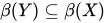

A similar characterization can also be made using brambles, families of connected subgraphs that all touch each other (meaning either that they share a vertex or are connected by an edge). The order of a bramble is the smallest hitting set for the family of subgraphs, and the treewidth of a graph is one less than the maximum order of a bramble.

02Examples
Every complete graph 

A connected graph with at least two vertices has treewidth 1 if and only if it is a tree. A tree has treewidth one by the same reasoning as for complete graphs (namely, it is chordal, and has maximum clique size two). Conversely, if a graph has a cycle, then every chordal completion of the graph includes at least one triangle consisting of three consecutive vertices of the cycle, from which it follows that its treewidth is at least two.

03Bounded treewidth
Graph families with bounded treewidth
For any fixed constant
The planar graphs do not have bounded treewidth, because the 


- One of the finitely many forbidden minors characterizing
Forbidden minors
For every finite value of
- For
, the unique forbidden minor is a 3-vertex cycle graph.
- For
, the unique forbidden minor is the 4-vertex complete graph
.
- For
, there are four forbidden minors:
, the graph of the octahedron, the pentagonal prism graph, and the Wagner graph. Of these, the two polyhedral graphs are planar.
For larger values of 
04Algorithms
Computing the treewidth
It is 
Due to the roles the treewidth plays in an enormous number of fields, different practical and theoretical algorithms computing the treewidth of a graph were developed. Depending on the application on hand, one can prefer better approximation ratio, or better dependence in the running time from the size of the input or the treewidth.
The table below provides an overview of some of the treewidth algorithms. Here 


 )
)


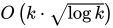


It is not known whether determining the treewidth of planar graphs is NP-complete, or whether their treewidth can be computed in polynomial time.
In practice, an algorithm of Shoikhet & Geiger (1997) can determine the treewidth of graphs with up to 100 vertices and treewidth up to 11, finding a chordal completion of these graphs with the optimal treewidth.
For larger graphs, one can use search-based techniques such as branch and bound search to compute the treewidth. These algorithms are anytime in that when stopped early, they will output an upper bound on the treewidth. An algorithm of this type was proposed in 2004 by Vibhav Gogate and Rina Dechter. To provide a lower bound on treewidth for the branches of this search, they construct a graph minor by repeatedly contracting an edge between a minimum degree vertex and one of its neighbors, until just one vertex remains. The maximum of the minimum degree over these constructed minors is guaranteed to be a lower bound on the treewidth of the graph. Alex Dow and Rich Korf further improved this algorithm using best-first search.
Solving other problems on graphs of small treewidth
At the beginning of the 1970s, it was observed that a large class of combinatorial optimization problems defined on graphs could be efficiently solved by non serial dynamic programming as long as the graph had a bounded dimension, a parameter shown to be equivalent to treewidth by Bodlaender (1998). Later, several authors independently observed at the end of the 1980s that many algorithmic problems that are NP-complete for arbitrary graphs may be solved efficiently by dynamic programming for graphs of bounded treewidth, using the tree-decompositions of these graphs.
As an example, the problem of coloring a graph of treewidth 
Courcelle's theorem
For a large class of problems, there is a linear time algorithm to solve a problem from the class if a tree-decomposition with constant bounded treewidth is provided. Specifically, Courcelle's theorem states that if a graph problem can be expressed in the logic of graphs using monadic second order logic, then it can be solved in linear time on graphs with bounded treewidth. Monadic second order logic is a language to describe graph properties that uses the following constructions:
- Logic operations, such as
- Membership tests, such as
,
- Quantifications over vertices, edges, sets of vertices, and/or sets of edges, such as
,
,
,
- Vertex-edge incidence tests (
is an endpoint of
), and some extensions that allow for things such as optimization.


Consider for example the 3-coloring problem for graphs. For a graph 


05Related parameters
Pathwidth
The pathwidth of a graph has a very similar definition to treewidth via tree decompositions, but is restricted to tree decompositions in which the underlying tree of the decomposition is a path graph. Alternatively, the pathwidth may be defined from interval graphs analogously to the definition of treewidth from chordal graphs. As a consequence, the pathwidth of a graph is always at least as large as its treewidth, but it can only be larger by a logarithmic factor. Another parameter, the graph bandwidth, has an analogous definition from proper interval graphs, and is at least as large as the pathwidth. Other related parameters include the tree-depth, a number that is bounded for a minor-closed graph family if and only if the family excludes a path, and the degeneracy, a measure of the sparsity of a graph that is at most equal to its treewidth.
Grid minor size
Because the treewidth of an 


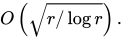
(For the 
Diameter and local treewidth
A family
It is also possible for a class of graphs that is not closed under minors to have bounded local treewidth. In particular this is trivially true for a class of bounded degree graphs, as bounded diameter subgraphs have bounded size. Another example is given by 1-planar graphs, graphs that can be drawn in the plane with one crossing per edge, and more generally for the graphs that can be drawn on a surface of bounded genus with a bounded number of crossings per edge. As with minor-closed graph families of bounded local treewidth, this property has pointed the way to efficient approximation algorithms for these graphs.
Hadwiger number and S-functions
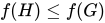
Halin (1976) defines a class of graph parameters that he calls S-functions, which include the treewidth. These functions from graphs to integers are required to be zero on graphs with no edges, to be minor-monotone (a function 
Sources and credits
This article is adapted from the Wikipedia article “Treewidth”, written by its contributors and licensed under CC BY-SA 4.0. Fathomly has changed the layout, removed citation markers, navigation and maintenance notices, and adjusted punctuation. This adapted version is shared under the same license. For references, see the original article.
Images, from Wikimedia Commons:
- Tree decomposition.svg by David Eppstein, Public domain
- 3x3 grid graph haven.svg by David Eppstein, CC0
- Partial 3-tree forbidden minors.svg by David Eppstein, Public domain
Fathomly is not affiliated with or endorsed by the Wikimedia Foundation. Spotted a problem? Tell us.