Graph bandwidth
Node labeling problem in graph theory
In graph theory, the graph bandwidth problem may be visualized as placing the vertices of a given graph at distinct integer positions along the number line so that the length of the longest edge is minimized. Such placement is called linear graph arrangement, linear graph layout or linear graph placement.
It may be formalized as labeling the 




The weighted graph bandwidth problem is a generalization wherein the edges are assigned weights 

In terms of matrices, the (unweighted) graph bandwidth is the minimal bandwidth of a symmetric matrix which is an adjacency matrix of the graph. The bandwidth may also be defined as one less than the maximum clique size in a proper interval supergraph of the given graph, chosen to minimize its clique size.
01Bandwidth formulas for some graphs
For several families of graphs, the bandwidth 
The bandwidth of a path graph 





For the hypercube graph 

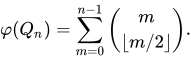
The bandwidth of the 


02Bounds
The bandwidth of a graph can be bounded in terms of various other graph parameters. For instance, letting χ(G) denote the chromatic number of G,

letting diam(G) denote the diameter of G, the following inequalities hold:

where
If a graph G has bandwidth k, then its pathwidth is at most k, and its tree-depth is at most k log(n/k). In contrast, as noted in the previous section, the star graph Sk, a structurally very simple example of a tree, has comparatively large bandwidth. Observe that the pathwidth of Sk is 1, and its tree-depth is 2.
Some graph families of bounded degree have sublinear bandwidth: if T is a tree of maximum degree at most ∆, then
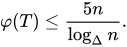
More generally, for planar graphs of bounded maximum degree at most ∆, a similar bound holds:
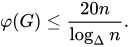
03Computing the bandwidth
Both the unweighted and weighted versions are special cases of the quadratic bottleneck assignment problem.
The bandwidth problem is NP-hard, even for some special cases. Regarding the existence of efficient
approximation algorithms, it is known that the bandwidth is NP-hard to approximate within any constant, and this even holds when the input graphs are restricted to caterpillar trees with maximum hair length 2. For arbitrary graphs with 
04Applications
The interest in this problem comes from some application areas.
One area is sparse matrix/band matrix handling, and general algorithms from this area, such as Cuthill-McKee algorithm, may be applied to find approximate solutions for the graph bandwidth problem.
Another application domain is in electronic design automation. In standard cell design methodology, typically standard cells have the same height, and their placement is arranged in a number of rows. In this context, graph bandwidth problem models the problem of placement of a set of standard cells in a single row with the goal of minimizing the maximal propagation delay (which is assumed to be proportional to wire length).
Sources and credits
This article is adapted from the Wikipedia article “Graph bandwidth”, written by its contributors and licensed under CC BY-SA 4.0. Fathomly has changed the layout, removed citation markers, navigation and maintenance notices, and adjusted punctuation. This adapted version is shared under the same license. For references, see the original article.
Fathomly is not affiliated with or endorsed by the Wikimedia Foundation. Spotted a problem? Tell us.
