Hypercube graph
Graphs formed by a hypercube's edges and vertices

In graph theory, the hypercube graph 


The hypercube graph 
Hypercube graphs should not be confused with cubic graphs, which are graphs that have exactly three edges touching each vertex. The only hypercube graph
01Construction
The hypercube graph
Alternatively,
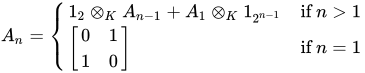
The above construction gives a recursive algorithm for constructing the adjacency matrix of a hypercube, 



![Construction of 3</sub>"}},"i":0}}]}' id="mwKQ">Q3 by connecting pairs of corresponding vertices in two copies of Q2](https://thumb.wikimedia.org/wikipedia/commons/thumb/a/aa/Hypercubeconstruction.png/500px-Hypercubeconstruction.png)
02Examples
The graph 


The graph
The graph 


03Properties
Bipartiteness
Every hypercube graph is bipartite: it can be colored with only two colors. The two colors of this coloring may be found from the subset construction of hypercube graphs, by giving one color to the subsets that have an even number of elements and the other color to the subsets with an odd number of elements.
Hamiltonicity
Every hypercube 


Hamiltonicity of the hypercube is tightly related to the theory of Gray codes. More precisely there is a bijective correspondence between the set of
A lesser known fact is that every perfect matching in the hypercube extends to a Hamiltonian cycle. The question whether every matching extends to a Hamiltonian cycle remains an open problem.
Other properties
The hypercube graph
- is the Hasse diagram of a finite Boolean algebra.
- is a median graph. Every median graph is an isometric subgraph of a hypercube, and can be formed as a retraction of a hypercube.
- has more than
perfect matchings. (this is another consequence that follows easily from the inductive construction.)
- is arc transitive and symmetric. The symmetries of hypercube graphs can be represented as signed permutations.
- contains all the cycles of length
and is thus a bipancyclic graph.
- can be drawn as a unit distance graph in the Euclidean plane by using the construction of the hypercube graph from subsets of a set of
at the sum of the vectors in
- is a n-vertex-connected graph, by Balinski's theorem.
- is planar (can be drawn with no crossings) if and only if
. For larger values of
.
- has exactly
spanning trees.
- has bandwidth exactly
.
- has achromatic number proportional to
, but the constant of proportionality is not known precisely.
- has as the eigenvalues of its adjacency matrix the numbers
and as the eigenvalues of its Laplacian matrix the numbers
. The
th eigenvalue has multiplicity
in both cases.
- has isoperimetric number
.
The family

04Problems
The problem of finding the longest path or cycle that is an induced subgraph of a given hypercube graph is known as the snake-in-the-box problem.
Szymanski's conjecture concerns the suitability of a hypercube as a network topology for communications. It states that, no matter how one chooses a permutation connecting each hypercube vertex to another vertex with which it should be connected, there is always a way to connect these pairs of vertices by paths that do not share any directed edge.
Sources and credits
This article is adapted from the Wikipedia article “Hypercube graph”, written by its contributors and licensed under CC BY-SA 4.0. Fathomly has changed the layout, removed citation markers, navigation and maintenance notices, and adjusted punctuation. This adapted version is shared under the same license. For references, see the original article.
Images, from Wikimedia Commons:
- Hypercubestar.svg by Watchduck You can name the author as "T. Piesk", "Tilman Piesk" or "Watchduck"., Public domain
- Hypercubeconstruction.png by Stdazi at English Wikipedia, Public domain
- Gray code tesseract 432.svg by Cmglee, CC BY-SA 4.0
- Snakes and coils in the box.svg by Cmglee, CC BY-SA 4.0
Fathomly is not affiliated with or endorsed by the Wikimedia Foundation. Spotted a problem? Tell us.
