Regular graph
Graph where each vertex has the same number of neighbors
In graph theory, a regular graph is a graph where each vertex has the same number of neighbors; i.e. every vertex has the same degree or valency. A regular directed graph must also satisfy the stronger condition that the indegree and outdegree of each internal vertex are equal to each other. A regular graph with vertices of degree k is called a k‑regular graph or regular graph of degree k.
01Special cases
Regular graphs of degree at most 2 are easy to classify: a 0-regular graph consists of disconnected vertices, a 1-regular graph consists of disconnected edges, and a 2-regular graph consists of a disjoint union of cycles and infinite chains.
In analogy with the terminology for polynomials of low degrees, a 3-regular or 4-regular graph often is called a cubic graph or a quartic graph, respectively. Similarly, it is possible to denote k-regular graphs with 
A strongly regular graph is a regular graph where every adjacent pair of vertices has the same number l of neighbors in common, and every non-adjacent pair of vertices has the same number n of neighbors in common. The smallest graphs that are regular but not strongly regular are the cycle graph and the circulant graph on 6 vertices.
The complete graph Km is strongly regular for any m.
02Properties
By the degree sum formula, a k-regular graph with n vertices has 
A theorem by Nash-Williams says that every k‑regular graph on 2k + 1 vertices has a Hamiltonian cycle.
Let A be the adjacency matrix of a graph. Then the graph is regular if and only if 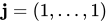


A regular graph of degree k is connected if and only if the eigenvalue k has multiplicity one. The "only if" direction is a consequence of the Perron-Frobenius theorem.
There is also a criterion for regular and connected graphs :
a graph is connected and regular if and only if the matrix of ones J, with 
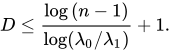
Let G be a k-regular graph with diameter D and eigenvalues of adjacency matrix 
03Existence
There exists a 


Proof: If a graph with n vertices is k-regular, then the degree k of any vertex v cannot exceed the number 
Conversely, if n and k are two natural numbers satisfying both the inequality and the parity condition, then indeed there is a k-regular circulant graph 


If 
04Generation
Fast algorithms exist to generate, up to isomorphism, all regular graphs with a given degree and number of vertices.
Sources and credits
This article is adapted from the Wikipedia article “Regular graph”, written by its contributors and licensed under CC BY-SA 4.0. Fathomly has changed the layout, removed citation markers, navigation and maintenance notices, and adjusted punctuation. This adapted version is shared under the same license. For references, see the original article.
Fathomly is not affiliated with or endorsed by the Wikimedia Foundation. Spotted a problem? Tell us.
