Random regular graph
A random r-regular graph is a graph selected from 


01Properties of random regular graphs
As with more general random graphs, it is possible to prove that certain properties of random 


If 


then, asymptotically almost surely, a random r-regular graph has diameter at most d. There is also a (more complex) lower bound on the diameter of r-regular graphs, so that almost all r-regular graphs (of the same size) have almost the same diameter.
The distribution of the number of short cycles is also known: for fixed 


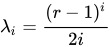
02Algorithms for random regular graphs
It is non-trivial to implement the random selection of r-regular graphs efficiently and in an unbiased way, since most graphs are not regular. The pairing model (also configuration model) is a method which takes nr points, and partitions them into n buckets with r points in each of them. Taking a random matching of the nr points, and then contracting the r points in each bucket into a single vertex, yields an r-regular graph or multigraph. If this object has no multiple edges or loops (i.e. it is a graph), then it is the required result. If not, a restart is required.
A refinement of this method was developed by Brendan McKay and Nicholas Wormald.
Sources and credits
This article is adapted from the Wikipedia article “Random regular graph”, written by its contributors and licensed under CC BY-SA 4.0. Fathomly has changed the layout, removed citation markers, navigation and maintenance notices, and adjusted punctuation. This adapted version is shared under the same license. For references, see the original article.
Fathomly is not affiliated with or endorsed by the Wikimedia Foundation. Spotted a problem? Tell us.