Structural dynamics
Behavior of structures subjected to time-varying loading
Structural dynamics is a branch of structural analysis which covers the behavior of a structure subjected to dynamic loading. Dynamic loading is any time-varying loading which changes quickly enough that the response of the structure differs from the response to the same loading applied statically. Causes of dynamic loading include people, wind, waves, traffic, earthquakes, and blasts. Dynamic analysis can be used to find dynamic displacements, time history, and natural frequencies and mode shapes.
Whether a given load should be treated as static or dynamic depends on how quickly the load varies in comparison to the structure's natural frequency. If it changes slowly, the structure's response may be determined with static analysis, but if it varies quickly (relative to the structure's ability to respond), the response must be determined with a dynamic analysis.
Dynamic analysis for simple structures can be carried out analytically, but for complex structures finite element analysis is more often used to calculate the mode shapes and frequencies.
01Applications
Structural dynamics is applied in a number of engineering fields, including

02Dynamic loading
Structural analysis is mainly concerned with finding out the behavior (forces or displacements) of a physical structure when subjected to force. This action can be in the form of load due to the weight of things such as people, furniture, wind, snow, etc. or some other kind of excitation such as an earthquake, shaking of the ground due to a blast nearby, etc. All loads are dynamic in the literal sense, because at some point in time they were not present. The distinction is made between the dynamic and the static analysis on the basis of whether the applied action has enough acceleration in comparison to the structure's natural frequency. If a load is applied sufficiently slowly, the inertia forces (Newton's first law of motion) can be ignored and the analysis can be simplified as static analysis.
Dynamic loads on a structure can be categorized as periodic or non-periodic. Periodic loads may be simple harmonic, as in the case of a rotating machine with an unbalanced flywheel (a familiar example is a washing machine operating at a steady speed), or they may be more complex but representable by a Fourier series. Non-periodic loads include impulsive (very short duration) loading caused by blasts or impacts, and longer duration loads including earthquakes and wind. In the case of random excitation, the amplitude-time history of the load and the structural response are defined in terms of statistical distributions.
03Displacements
A dynamic load can have a significantly larger effect than a static load of the same magnitude due to the structure's inability to respond quickly to the loading (by deflecting). The increase in the effect of a dynamic load is given by the dynamic amplification factor (DAF) or dynamic load factor (DLF):
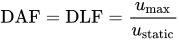
where u is the deflection of the structure due to the applied load.
Graphs of dynamic amplification factors vs non-dimensional rise time (tr/T) exist for standard loading functions (for an explanation of rise time, see time history analysis below). Hence the DAF for a given loading can be read from the graph, the static deflection can be easily calculated for simple structures and the dynamic deflection found.
04Time history analysis
A full time history will give the response of a structure over time during and after the application of a load. To find the full time history of a structure's response, you must solve the structure's equation of motion.
Example
A simple single degree of freedom system (a mass, M, on a spring of stiffness k, for example) has the following equation of motion:

where 
If the loading F(t) is a Heaviside step function (the sudden application of a constant load), the solution to the equation of motion is:
![x={\frac {F_{0}}{k}}[1-\cos(\omega t)]](https://wikimedia.org/api/rest_v1/media/math/render/svg/b0ef0b18fd3d516d6714dd0706a17fae51ced0f6)
where 

The static deflection of a single degree of freedom system is:

so we can write, by combining the above formulae:
![x=x_{\text{static}}[1-\cos(\omega t)]](https://wikimedia.org/api/rest_v1/media/math/render/svg/d5c97a8a732b6fc2ed30ab2059a336587e777a81)
This gives the (theoretical) time history of the structure due to a load F(t), where the false assumption is made that there is no damping.
Although this is too simplistic to apply to a real structure, the Heaviside step function is a reasonable model for the application of many real loads, such as the sudden addition of a piece of furniture, or the removal of a prop to a newly cast concrete floor. However, in reality loads are never applied instantaneously, they build up over a period of time (this may be very short indeed). This time is called the rise time.
As the number of degrees of freedom of a structure increases it very quickly becomes too difficult to calculate the time history manually, real structures are analysed using non-linear finite element analysis software.
05Damping
Any real structure will dissipate energy (mainly through friction). This can be modelled by modifying the DAF

where 
- Bolted steel ~6%
- Reinforced concrete ~5%
- Welded steel ~2%
- Brick masonry ~10%
Methods to increase damping
One of the widely used methods to increase damping is to attach a layer of material with a high Damping Coefficient, for example rubber, to a vibrating structure.
06Modal analysis
A modal analysis calculates the frequency modes or natural frequencies of a given system, but not necessarily its full-time history response to a given input. The natural frequency of a system is dependent only on the stiffness of the structure and the mass which participates with the structure (including self-weight). It is not dependent on the load function.
It is useful to know the modal frequencies of a structure as it allows you to ensure that the frequency of any applied periodic loading will not coincide with a modal frequency and hence cause resonance, which leads to large oscillations.
The method is:
- Find the natural modes (the shape adopted by a structure) and natural frequencies
- Calculate the response of each mode
- Optionally superpose the response of each mode to find the full modal response to a given loading
Energy method
It is possible to calculate the frequency of different mode shape of system manually by the energy method. For a given mode shape of a multiple degree of freedom system you can find an "equivalent" mass, stiffness and applied force for a single degree of freedom system. For simple structures the basic mode shapes can be found by inspection, but it is not a conservative method. Rayleigh's principle states:
"The frequency ω of an arbitrary mode of vibration, calculated by the energy method, is always greater than, or equal to, the fundamental frequency ωn."
For an assumed mode shape 



then, as above:

Modal response
The complete modal response to a given load F(x,t) is 
- Superpose complete time histories of each mode (time consuming, but exact)
- Superpose the maximum amplitudes of each mode (quick but conservative)
- Superpose the square root of the sum of squares (good estimate for well-separated frequencies, but unsafe for closely spaced frequencies)
To superpose the individual modal responses manually, having calculated them by the energy method:
Assuming that the rise time tr is known (T = 2π/ω), it is possible to read the DAF from a standard graph. The static displacement can be calculated with 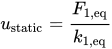

07Modal participation factor
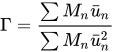
For real systems there is often mass participating in the forcing function (such as the mass of ground in an earthquake) and mass participating in inertia effects (the mass of the structure itself, Meq). The modal participation factor Γ is a comparison of these two masses. For a single degree of freedom system Γ = 1.
Sources and credits
This article is adapted from the Wikipedia article “Structural dynamics”, written by its contributors and licensed under CC BY-SA 4.0. Fathomly has changed the layout, removed citation markers, navigation and maintenance notices, and adjusted punctuation. This adapted version is shared under the same license. For references, see the original article.
Images, from Wikimedia Commons:
- Mass spring.svg by en:User:Pbroks13, Public domain
Fathomly is not affiliated with or endorsed by the Wikimedia Foundation. Spotted a problem? Tell us.