Dynamic amplification factor
Dimensionless number in physics
Dynamic Amplification Factor (DAF) or Dynamic Increase Factor (DIF), is a dimensionless number which describes how many times the deflections or stresses should be multiplied to the deflections or stresses caused by the static loads when a dynamic load is applied on to a structure.
When lifting an object during a sub-sea operation, the DAF is calculated based on dynamic hydraulic forces or on snap-forces.
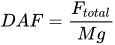
Where:
is the mass of the object in air (kg)
is the acceleration of gravity (9.81m/s2)
is the largest of
or
(N)
Sources and credits
This article is adapted from the Wikipedia article “Dynamic amplification factor”, written by its contributors and licensed under CC BY-SA 4.0. Fathomly has changed the layout, removed citation markers, navigation and maintenance notices, and adjusted punctuation. This adapted version is shared under the same license. For references, see the original article.
Fathomly is not affiliated with or endorsed by the Wikimedia Foundation. Spotted a problem? Tell us.