String diagram
Graphical representation of a morphism
In mathematics, string diagrams are a formal graphical language for representing morphisms in monoidal categories, or more generally 2-cells in 2-categories. They are a prominent tool in applied category theory. When interpreted in FinVect, the monoidal category of finite-dimensional vector spaces and linear maps with the tensor product, string diagrams are called tensor networks or Penrose graphical notation. This has led to the development of categorical quantum mechanics where the axioms of quantum theory are expressed in the language of monoidal categories.
01History
Günter Hotz gave the first mathematical definition of string diagrams in order to formalise electronic circuits. However, the invention of string diagrams is usually credited to Roger Penrose, with Feynman diagrams also described as a precursor. They were later characterised as the arrows of free monoidal categories in a seminal article by André Joyal and Ross Street. While the diagrams in these first articles were hand-drawn, the advent of typesetting software such as LaTeX and PGF/TikZ made the publication of string diagrams more widespread.
The existential graphs and diagrammatic reasoning of Charles Sanders Peirce are arguably the oldest form of string diagrams, they are interpreted in the monoidal category of finite sets and relations with the Cartesian product. The lines of identity of Peirce's existential graphs can be axiomatised as a Frobenius algebra, the cuts are unary operators on homsets that axiomatise logical negation. This makes string diagrams a sound and complete two-dimensional deduction system for first-order logic, invented independently from the one-dimensional syntax of Gottlob Frege's Begriffsschrift.
02Intuition
String diagrams are made of boxes 


- each box
- for each list of wires
is a string diagram representing the process which does nothing to its input system, it is drawn as a bunch of parallel wires,
- for each pair of string diagrams
, their tensor
is a string diagram representing the parallel composition of processes, it is drawn as the horizontal concatenation of the two diagrams,
- for each pair of string diagrams
, their composition
is a string diagram representing the sequential composition of processes, it is drawn as the vertical concatenation of the two diagrams.
03Definition
Algebraic
Let the Kleene star 

A monoidal signature 
- a set
of generating objects, the lists of generating objects in
are also called types,
- a set
of generating arrows, also called boxes,
- a pair of functions
which assign a domain and codomain to each box, i.e. the input and output types.
A morphism of monoidal signature 
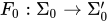




There is a forgetful functor 


String diagrams (with generators from 


Geometric
A topological graph, also called a one-dimensional cell complex, is a tuple 



A plane graph between two real numbers 

![\mathbb {R} \times [a,b]](https://wikimedia.org/api/rest_v1/media/math/render/svg/b7b35713c8f0fe44b3a69ad4678d19a895b646af)




A plane graph is progressive, also called recumbent, when the vertical projection ![e\to [a,b]](https://wikimedia.org/api/rest_v1/media/math/render/svg/7dc3755f398e163cafd16db198831b05fba5ab83)


A plane graph is generic when the vertical projection ![\Gamma _{0}-\{a,b\}\times \mathbb {R} \to [a,b]](https://wikimedia.org/api/rest_v1/media/math/render/svg/9d64d3fb7b7b27592a48284f68c0d23f8fd8d58e)
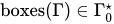
A progressive plane graph is labeled by a monoidal signature 

A deformation of plane graphs is a continuous map ![h:\Gamma \times [0,1]\to [a,b]\times \mathbb {R}](https://wikimedia.org/api/rest_v1/media/math/render/svg/e6cb1d08481f3cec2c0a1cea024c382c23d326f1)
- the image of
defines a plane graph for all
,
- for all
is an inner node for some
it is inner for all
A deformation is progressive (generic, labeled) if 


- the identity diagram
as a set of parallel edges labeled by some type
,
- the composition of two diagrams as their vertical concatenation with the codomain of the first identified with the domain of the second,
- the tensor of two diagrams as their horizontal concatenation.
Combinatorial
While the geometric definition makes explicit the link between category theory and low-dimensional topology, a combinatorial definition is necessary to formalise string diagrams in computer algebra systems and use them to define computational problems. One such definition is to define string diagrams as equivalence classes of well-typed formulae generated by the signature, identity, composition and tensor. In practice, it is more convenient to encode string diagrams as formulae in generic form, which are in bijection with the labeled generic progressive plane graphs defined above.
Fix a monoidal signature 


- a domain
as starting point
- a length
,
- a list of

such that 






- the identity diagram
and
,
- the composition of two diagrams as the concatenation of their list of layers,
- the tensor of two diagrams as the composition of whiskerings
.
Note that because the diagram is in generic form (i.e. each layer contains exactly one box) the definition of tensor is necessarily biased: the diagram on the left hand-side comes above the one on the right-hand side. One could have chosen the opposite definition 
Two diagrams are equal (up to the axioms of monoidal categories) whenever they are in the same equivalence class of the congruence relation generated by the interchanger:
The word problem for free monoidal categories, i.e. deciding whether two given diagrams are equal, can be solved in polynomial time. The interchanger is a confluent rewriting system on the subset of boundary connected diagrams, i.e. whenever the plane graphs have no more than one connected component which is not connected to the domain or codomain and the Eckmann-Hilton argument does not apply.
04Extension to 2-categories
The idea is to represent structures of dimension d by structures of dimension 2-d, using Poincaré duality. Thus,
- an object is represented by a portion of plane,
- a 1-cell
is represented by a vertical segment, called a string, separating the plane in two (the right part corresponding to A and the left one to B),
- a 2-cell
is represented by an intersection of strings (the strings corresponding to f above the link, the strings corresponding to g below the link).
The parallel composition of 2-cells corresponds to the horizontal juxtaposition of diagrams and the sequential composition to the vertical juxtaposition of diagrams.
A monoidal category is equivalent to a 2-category with a single 0-cell. Intuitively, going from monoidal categories to 2-categories amounts to adding colours to the background of string diagrams.
05Examples
The snake equation
Consider an adjunction 


The string corresponding to the identity functor is drawn as a dotted line and can be omitted. The definition of an adjunction requires the following equalities:

The first one is depicted as
A monoidal category where every object has a left and right adjoint is called a rigid category. String diagrams for rigid categories can be defined as non-progressive plane graphs, i.e. the edges can bend backward.
In the context of categorical quantum mechanics, this is known as the snake equation.
The category of Hilbert spaces is rigid, this fact underlies the proof of correctness for the quantum teleportation protocol. The unit and counit of the adjunction are an abstraction of the Bell state and the Bell measurement respectively. If Alice and Bob share two qubits Y and Z in an entangled state and Alice performs a (post-selected) entangled measurement between Y and another qubit X, then this qubit X will be teleported from Alice to Bob: quantum teleportation is an identity morphism.
The same equation appears in the definition of pregroup grammars where it captures the notion of information flow in natural language semantics. This observation has led to the development of the DisCoCat framework and quantum natural language processing.
06Hierarchy of graphical languages
Many extensions of string diagrams have been introduced to represent arrows in monoidal categories with extra structure, forming a hierarchy of graphical languages which is classified in Selinger's Survey of graphical languages for monoidal categories.
- Braided monoidal categories with 3-dimensional diagrams, a generalisation of braid groups.
- Symmetric monoidal categories with 4-dimensional diagrams where edges can cross, a generalisation of the symmetric group.
- Ribbon categories with 3-dimensional diagrams where the edges are undirected, a generalisation of knot diagrams.
- Compact closed categories with 4-dimensional diagrams where the edges are undirected, a generalisation of Penrose graphical notation.
- Dagger categories where every diagram has a horizontal reflection.
07List of applications
String diagrams have been used to formalise the following objects of study.
- Concurrency theory
- Artificial neural networks
- Game theory
- Bayesian probability
- Consciousness
- Markov kernels
- Signal-flow graphs
- Conjunctive queries
- Bidirectional transformations
- Categorical quantum mechanics
- Quantum circuits, measurement-based quantum computing and quantum error correction, see ZX-calculus
- Natural language processing, see DisCoCat
- Quantum natural language processing
Sources and credits
This article is adapted from the Wikipedia article “String diagram”, written by its contributors and licensed under CC BY-SA 4.0. Fathomly has changed the layout, removed citation markers, navigation and maintenance notices, and adjusted punctuation. This adapted version is shared under the same license. For references, see the original article.
Fathomly is not affiliated with or endorsed by the Wikimedia Foundation. Spotted a problem? Tell us.
