One-way quantum computer
Method of quantum computing

The one-way quantum computer, also known as measurement-based quantum computer (MBQC), is a method of quantum computing that first prepares an entangled resource state, usually a cluster state or graph state, then performs single qubit measurements on it. It is "one-way" because the resource state is destroyed by the measurements.
The outcome of each individual measurement is random, but they are related in such a way that the computation always succeeds. In general, the choices of basis for later measurements need to depend on the results of earlier measurements, and hence the measurements cannot all be performed at the same time.
The implementation of MBQC is mainly considered for photonic devices, due to the difficulty of entangling photons without measurements, and the simplicity of creating and measuring them. However, MBQC is also possible with matter-based qubits. The process of entanglement and measurement can be described with the help of graph tools and group theory, in particular by the elements from the stabilizer group.
01Definition
The purpose of quantum computing focuses on building an information theory with the features of quantum mechanics: instead of encoding a binary unit of information (bit), which can be switched to 1 or 0, a quantum binary unit of information (qubit) can simultaneously turn to be 0 and 1 at the same time, thanks to the phenomenon called superposition. Another key feature for quantum computing relies on the entanglement between the qubits.
In the quantum logic gate model, a set of qubits, called register, is prepared at the beginning of the computation, then a set of logic operations over the qubits, carried by unitary operators, is implemented. A quantum circuit is formed by a register of qubits on which unitary transformations are applied over the qubits. In the measurement-based quantum computation, instead of implementing a logic operation via unitary transformations, the same operation is executed by entangling a number 


General procedure
The standard process of measurement-based quantum computing consists of three steps: entangle the qubits, measure the ancillae (auxiliary qubits) and correct the outputs. In the first step, the qubits are entangled in order to prepare the source state. In the second step, the ancillae are measured, affecting the state of the output qubits. However, the measurement outputs are non-deterministic result, due to undetermined nature of quantum mechanics: in order to carry on the computation in a deterministic way, some correction operators, called byproducts, are introduced.
Preparing the source state
At the beginning of the computation, the qubits can be distinguished into two categories: the input and the ancillary qubits. The inputs represent the qubits set in a generic 


where 


.
A register with 


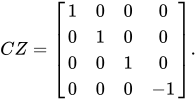
The action of a
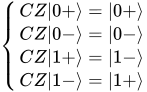
When applying a
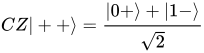
turns to be an entangled pair of qubits. When entangling two ancillae, no importance is given about which is the control qubit and which one the target, as far as the outcome turns to be the same. Similarly, as the
Photons are the most common qubit system that is used in the context of one-way quantum computing. However, deterministic
Measuring the qubits
The process of measurement over a single-particle state can be described by projecting the state on the eigenvector of an observable. Consider an observable 


.
The actual state of the 

,
where 





Correcting the output
After all the measurements have been performed, the system has been reduced to a smaller number of qubits, which form the output state of the system. Due to the probabilistic outcome of measurements, the system is not set in a deterministic way: after a measurement on the 


02CME pattern
The operations of entanglement, measurement and correction can be performed in order to implement unitary gates. Such operations can be performed time by time for any logic gate in the circuit, or rather in a pattern which allocates all the entanglement operations at the beginning, the measurements in the middle and the corrections at the end of the circuit. Such pattern of computation is referred to as CME standard pattern. In the CME formalism, the operation of entanglement between the 


When performing a computation following the CME pattern, it may happen that two measurements 

![[M_{j}^{\theta _{2}}]^{s_{i}}M_{i}^{\theta _{1}}](https://wikimedia.org/api/rest_v1/media/math/render/svg/fc69664a662aa4a17d6749ef76e0555813501015)


![[M_{j}^{\theta _{2}}]^{s_{i}}](https://wikimedia.org/api/rest_v1/media/math/render/svg/173109386f20e746e03f038cc5fd24d73ba02fd0)

An example: Euler rotations
As an illustrative example, consider the Euler rotation in the 
,
where 

,
where the input state 
In the second place, the first and the second qubits must be measured by the 


![[M_{2}^{-\lambda }]^{s_{1}}](https://wikimedia.org/api/rest_v1/media/math/render/svg/ed948d49a87b0e1f31add26b853d041ae9b1cd2d)


![[M_{3}^{\theta }]^{s_{2}}](https://wikimedia.org/api/rest_v1/media/math/render/svg/de092d115b3e9be1bb0308d344bf7b17785e5344)
![[M_{4}^{\phi }]^{s_{1}+s_{3}}](https://wikimedia.org/api/rest_v1/media/math/render/svg/0878b5f51f0c15ae0e91029217be3bf639fd3a50)


At last, the corrections 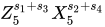


As seen in such example, in the measurement-based computation model, the physical input qubit (the first one) and output qubit (the third one) may differ each other.

03Equivalence between quantum circuit model and MBQC
The one-way quantum computer allows the implementation of a circuit of unitary transformations through the operations of entanglement and measurement. At the same time, any quantum circuit can be in turn converted into a CME pattern: a technique to translate quantum circuits into a MBQC pattern of measurements has been formulated by V. Danos et al.
Such conversion can be carried on by using a universal set of logic gates composed by the 
.
The

which means, to implement a 


Standardization
In order to move all the
.


The entanglement operator 

Pauli simplification
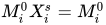
The measurement operations
,
![M_{i}^{\theta }X_{i}^{s}=[M_{i}^{\theta }]^{s}](https://wikimedia.org/api/rest_v1/media/math/render/svg/7c0eaaeddc71ff0ac3d9cbee71cffb67d1a1d2ca)
where ![[M_{i}^{\theta }]^{s}=M_{i}^{(-)^{s}\theta }](https://wikimedia.org/api/rest_v1/media/math/render/svg/89c4c5a7f8f57342e77a777f377c01c2e9dd9502)

.
Signal shifting
The action of the signal shifting operator
.
![X_{i}^{s}S_{i}^{t}=S_{i}^{t}X_{i}^{s[(s_{i}+t)/s_{i}]}](https://wikimedia.org/api/rest_v1/media/math/render/svg/eeb4512a8565c0430caf8deb3e4582730c417109)
The ![s[(t+s_{i})/s_{i}]](https://wikimedia.org/api/rest_v1/media/math/render/svg/6f016f117311d8fc11bf374849ccf3a1cacd8c8c)





04Stabilizer formalism
When preparing the source state of entangled qubits, a graph representation can be given by the stabilizer group. The stabilizer group 



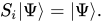
Of course, 
It is therefore possible to define a 


,
where 
.
While the number of 

The Clifford group
The Clifford group 
.
The Clifford group requires three generators, which can be chosen as the Hadamard gate 


.
Consider a state 
.
Therefore, the 

The Gottesman-Knill theorem states that, given a set of logic gates from the Clifford group, followed by 


05Hardware and applications
Topological cluster state quantum computer
Measurement-based computation on a periodic 3D lattice cluster state can be used to implement topological quantum error correction. Topological cluster state computation is closely related to Kitaev's toric code, as the 3D topological cluster state can be constructed and measured over time by a repeated sequence of gates on a 2D array.
Implementations
One-way quantum computation has been demonstrated by running the 2 qubit Grover's algorithm on a 2x2 cluster state of photons. A linear optics quantum computer based on one-way computation has been proposed.
Cluster states have also been created in optical lattices, but were not used for computation as the atom qubits were too close together to measure individually.
AKLT state as a resource
It has been shown that the (spin 

Sources and credits
This article is adapted from the Wikipedia article “One-way quantum computer”, written by its contributors and licensed under CC BY-SA 4.0. Fathomly has changed the layout, removed citation markers, navigation and maintenance notices, and adjusted punctuation. This adapted version is shared under the same license. For references, see the original article.
Images, from Wikimedia Commons:
- Notation-as-it-relates-to-a-one-way-quantum-computation-3-copyright-2001-by-the-APS.png by Mercedes Gimeno-Segovia, Pete Shadbolt, Dan E. Browne, Terry Rudolph, Public domain
- Bernstein Vazirani quantum circuit.png by Vtomole, CC BY-SA 4.0
- Qcircuit CC.svg by Geek3, CC BY 3.0
- X-Z gates.png by SebastianoCorli, CC BY-SA 4.0
- Mbqc-fig-single qubit pattern.jpg by Institute for Quantum Computing, Baidu Inc., Public domain
- Three Vertex Graph.png by SebastianoCorli, CC BY-SA 4.0
Fathomly is not affiliated with or endorsed by the Wikimedia Foundation. Spotted a problem? Tell us.
