Star-mesh transform
Mathematical circuit analysis technique

The star-mesh transform, or star-polygon transform, is a mathematical circuit analysis technique to transform a resistive network into an equivalent network with one less node. The equivalence follows from the Schur complement identity applied to the Kirchhoff matrix of the network.
The equivalent impedance betweens nodes A and B is given by:
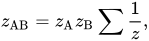
where 
The transform replaces N resistors with 

It is possible, though not necessarily efficient, to transform an arbitrarily complex two-terminal resistive network into a single equivalent resistor by repeatedly applying the star-mesh transform to eliminate each non-terminal node.
01Special cases
When N is:
- For a single dangling resistor, the transform eliminates the resistor.
- For two resistors, the "star" is simply the two resistors in series, and the transform yields a single equivalent resistor.
- The special case of three resistors is better known as the Y-Δ transform. Since the result also has three resistors, this transform has an inverse Δ-Y transform.
Sources and credits
This article is adapted from the Wikipedia article “Star-mesh transform”, written by its contributors and licensed under CC BY-SA 4.0. Fathomly has changed the layout, removed citation markers, navigation and maintenance notices, and adjusted punctuation. This adapted version is shared under the same license. For references, see the original article.
Images, from Wikimedia Commons:
- Star-mesh transform.svg by SlothMcCarty, CC BY-SA 3.0
Fathomly is not affiliated with or endorsed by the Wikimedia Foundation. Spotted a problem? Tell us.