Kron reduction
Power engineering technique
In power engineering, Kron reduction is a method used to reduce or eliminate the desired node without need of repeating the steps like in Gaussian elimination.
It is named after Hungarian American electrical engineer Gabriel Kron.
01Description
Kron reduction is a useful tool to eliminate unused nodes in a Y-parameter matrix. For example, three linear elements linked in series with a port at each end may be easily modeled as a 4X4 nodal admittance matrix of Y-parameters, but only the two port nodes normally need to be considered for modeling and simulation. Kron reduction may be used to eliminate the internal nodes, and thereby reducing the 4th order Y-parameter matrix to a 2nd order Y-parameter matrix. The 2nd order Y-parameter matrix is then more easily converted to a Z-parameter matrix or S-parameter matrix when needed.
Matrix operations
Consider a general Y-parameter matrix that may be created from a combination of linear elements constructed such that two internal nodes exist.
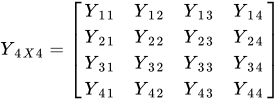
While it is possible to use the 4X4 matrix in simulations or to construct a 4X4 S-parameter matrix, is may be simpler to reduce the Y-parameter matrix to a 2X2 by eliminating the two internal nodes through Kron Reduction, and then simulating with a 2X2 matrix and/or converting to a 2X2 S-parameter or Z-Parameter matrix.

The process for executing a Kron reduction is as follows:
Select the Kth row/column used to model the undesired internal nodes to be eliminated. Apply the below formula to all other matrix entries that do not reside on the Kth row and column. Then simply remove the Kth row and column of the matrix, which reduces the size of the matrix by one.
Kron Reduction for the Kth row/column of an NxN matrix:

Linear elements that are also passive always form a symmetric Y-parameter matrix, that is, 
Kron Reduction for symmetric NxN matrices:
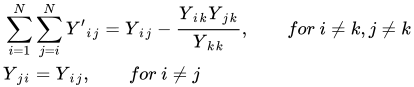
Once all the matrix entries have been modified by the Kron Reduction equation, the Kth row/column may be eliminated, and the matrix order is reduced by one. Repeat for all internal nodes desired to be eliminated
02Simplified theory and derivation
The concept behind Kron reduction is quite simple. Y-parameters are measured using nodes shorted to ground, but unused nodes, that is nodes without ports, are not necessarily grounded, and their state is not directly known to the outside. Therefore, the Y-parameter matrix of the full network does not adequately describe the Y-parameter of the network being modeled, and contains extraneous entries if some nodes do not have ports.
Consider the case of two lumped elements of equal value in series, two resistors of equal resistance for example. If both resistors have an admittance of 

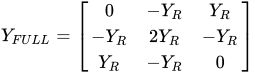
However, it is easily observed that the two resistors in series, each with an assigned admittance of Y, has a net admittance of
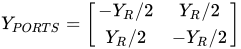
Since row and column 2 of the 

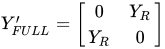
Now we have a basis to create the translation equation by finding an equation that translates each entry in 
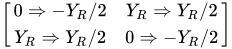
For each of the four entries, it can be observed that subtracting 


The same process may be used for elements of arbitrary admittance (
Sources and credits
This article is adapted from the Wikipedia article “Kron reduction”, written by its contributors and licensed under CC BY-SA 4.0. Fathomly has changed the layout, removed citation markers, navigation and maintenance notices, and adjusted punctuation. This adapted version is shared under the same license. For references, see the original article.
Fathomly is not affiliated with or endorsed by the Wikimedia Foundation. Spotted a problem? Tell us.
