Shift operator
Linear mathematical operator which translates a function
In mathematics, and in particular functional analysis, the shift operator, also known as the translation operator, is an operator that takes a function x ↦ f(x) to its translation x ↦ f(x + a). In time series analysis, the shift operator is called the lag operator.
Shift operators are examples of linear operators, important for their simplicity and natural occurrence. The shift operator action on functions of a real variable plays an important role in harmonic analysis, for example, it appears in the definitions of almost periodic functions, positive-definite functions, derivatives, and convolution. Shifts of sequences (functions of an integer variable) appear in diverse areas such as Hardy spaces, the theory of abelian varieties, and the theory of symbolic dynamics, for which the baker's map is an explicit representation. The notion of triangulated category is a categorified analogue of the shift operator.
01Definition
Functions of a real variable
The shift operator T t (where 


A practical operational calculus representation of the linear operator T t in terms of the plain derivative 

which may be interpreted operationally through its formal Taylor expansion in t; and whose action on the monomial xn is evident by the binomial theorem, and hence on all series in x, and so all functions f(x) as above. This, then, is a formal encoding of the Taylor expansion in Heaviside's calculus.
The operator thus provides the prototype for Lie's celebrated advective flow for Abelian groups,

where the canonical coordinates h (Abel functions) are defined such that

For example, it easily follows that 
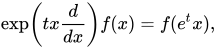
hence 






etc.
The initial condition of the flow and the group property completely determine the entire Lie flow, providing a solution to the translation functional equation

Sequences
The left shift operator acts on one-sided infinite sequence of numbers by

and on two-sided infinite sequences by

The right shift operator acts on one-sided infinite sequence of numbers by

and on two-sided infinite sequences by

The right and left shift operators acting on two-sided infinite sequences are called bilateral shifts. A finite-dimensional analog is given by the shift matrices.
Abelian groups
In general, as illustrated above, if F is a function on an abelian group G, and h is an element of G, the shift operator T g maps F to

02Properties of the shift operator
The shift operator acting on real- or complex-valued functions or sequences is a linear operator which preserves most of the standard norms which appear in functional analysis. Therefore, it is usually a continuous operator with norm one.
Action on Hilbert spaces
The shift operator acting on two-sided sequences is a unitary operator on 

In both cases, the (left) shift operator satisfies the following commutation relation with the Fourier transform:
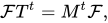
The one-sided shift S acting on 


The spectrum of S is the unit disk. The shift S is one example of a Fredholm operator; it has Fredholm index −1.
03Generalization
Jean Delsarte introduced the notion of generalized shift operator (also called generalized displacement operator); it was further developed by Boris Levitan.
A family of operators 

- Associativity: let
Then
- There exists e in X such that Le is the identity operator.

In this case, the set X is called a hypergroup.
Sources and credits
This article is adapted from the Wikipedia article “Shift operator”, written by its contributors and licensed under CC BY-SA 4.0. Fathomly has changed the layout, removed citation markers, navigation and maintenance notices, and adjusted punctuation. This adapted version is shared under the same license. For references, see the original article.
Fathomly is not affiliated with or endorsed by the Wikimedia Foundation. Spotted a problem? Tell us.
