Categorification
Connects set theory with category theory
In mathematics, categorification is the process of replacing set-theoretic theorems with category-theoretic analogues. Categorification, when done successfully, replaces sets with categories, functions with functors, and equations with natural isomorphisms of functors satisfying additional properties. The term was coined by Louis Crane.
The reverse of categorification is the process of decategorification. Decategorification is a systematic process by which isomorphic objects in a category are identified as equal. Whereas decategorification is a straightforward process, categorification is usually much less straightforward. In the representation theory of Lie algebras, modules over specific algebras are the principal objects of study, and there are several frameworks for what a categorification of such a module should be, e.g., so called (weak) abelian categorifications.
Categorification and decategorification are not precise mathematical procedures, but rather a class of possible analogues. They are used in a similar way to words like 'generalization', and not like 'sheafification'.
01Examples
One form of categorification takes a structure described in terms of sets, and interprets the sets as isomorphism classes of objects in a category. For example, the set of natural numbers can be seen as the set of cardinalities of finite sets (and any two sets with the same cardinality are isomorphic). In this case, operations on the set of natural numbers, such as addition and multiplication, can be seen as carrying information about coproducts and products of the category of finite sets. Less abstractly, the idea here is that manipulating sets of actual objects, and taking coproducts (combining two sets in a union) or products (building arrays of things to keep track of large numbers of them) came first. Later, the concrete structure of sets was abstracted away, taken "only up to isomorphism", to produce the abstract theory of arithmetic. This is a "decategorification", categorification reverses this step.
Other examples include homology theories in topology. Emmy Noether gave the modern formulation of homology as the rank of certain free abelian groups by categorifying the notion of a Betti number. See also Khovanov homology as a knot invariant in knot theory.
An example in finite group theory is that the ring of symmetric functions is categorified by the category of representations of the symmetric group. The decategorification map sends the Specht module indexed by partition 

essentially following the character map from a favorite basis of the associated Grothendieck group to a representation-theoretic favorite basis of the ring of symmetric functions. This map reflects how the structures are similar; for example
![\left[\operatorname {Ind} _{S_{m}\otimes S_{n}}^{S_{n+m}}(S^{\mu }\otimes S^{\nu })\right]\qquad {\text{and}}\qquad s_{\mu }s_{\nu }](https://wikimedia.org/api/rest_v1/media/math/render/svg/7da99c9ff95f889a39412e5a38cf73aa143d296e)
have the same decomposition numbers over their respective bases, both given by Littlewood-Richardson coefficients.
02Abelian categorifications
For an abelian category 

Let 


with

Let 

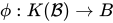

- the functor
lifts the action of
on the module
, and
- there are isomorphisms
, i.e. the composition
decomposes as the direct sum of functors
in the same way that the product
decomposes as the linear combination of basis elements
.
Sources and credits
This article is adapted from the Wikipedia article “Categorification”, written by its contributors and licensed under CC BY-SA 4.0. Fathomly has changed the layout, removed citation markers, navigation and maintenance notices, and adjusted punctuation. This adapted version is shared under the same license. For references, see the original article.
Fathomly is not affiliated with or endorsed by the Wikimedia Foundation. Spotted a problem? Tell us.
