Range of a function
Subset of a function's codomain

In mathematics, the range of a function may refer to either of two closely related concepts:
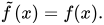
In some cases the codomain and the image of a function are the same set; such a function is called surjective or onto. For any non-surjective function 


01Definitions
Given two sets X and Y, a binary relation f between X and Y is a function (from X to Y) if for every element x in X there is exactly one y in Y such that f relates x to y. The sets X and Y are called the domain and codomain of f, respectively. The image of the function f is the subset of Y consisting of only those elements y of Y such that there is at least one x in X with f(x) = y.
02Usage
As the term "range" can have different meanings, it is considered a good practice to define it the first time it is used in a textbook or article. Older books, when they use the word "range", tend to use it to mean what is now called the codomain. More modern books, if they use the word "range" at all, generally use it to mean what is now called the image. To avoid any confusion, a number of modern books don't use the word "range" at all.
03Elaboration and example
Given a function

with domain 


As an example of the two different usages, consider the function 


For some functions, the image and the codomain coincide; these functions are called surjective or onto. For example, consider the function 
Even in cases where the image and codomain of a function are different, a new function can be uniquely defined with its codomain as the image of the original function. For example, as a function from the integers to the integers, the doubling function 


Sources and credits
This article is adapted from the Wikipedia article “Range of a function”, written by its contributors and licensed under CC BY-SA 4.0. Fathomly has changed the layout, removed citation markers, navigation and maintenance notices, and adjusted punctuation. This adapted version is shared under the same license. For references, see the original article.
Images, from Wikimedia Commons:
- Codomain2.SVG by en:User:Nguyen Huu Phuoc ([[:en:User talk:Phuoc Nguyen]talk]]), Public domain
Fathomly is not affiliated with or endorsed by the Wikimedia Foundation. Spotted a problem? Tell us.
