Family of sets
Any collection of sets, or subsets of a set
In set theory and related branches of mathematics, family or collection is used to mean set, indexed set, multiset, tuple, or class. It is usually used in phrases like "family of sets" because if one instead uses "set of sets" then the subsequent use of "set" can be confusing as to whether it is the containing set or one of the member sets. A common use is "family of subsets of some set S". A family of sets is also called a set family or a set system. A finite family of subsets of a finite set 
01Examples
The collection of all subsets of a given set 
A subset of 

Let 


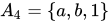
The class 
02Properties
Any family of subsets of a set
Any family of sets without repetitions is a subclass of the proper class of all sets (the universe).
Hall's marriage theorem, due to Philip Hall, gives necessary and sufficient conditions for a finite family of non-empty sets (repetitions allowed) to have a system of distinct representatives.
If 


The trace of a family 

03Related concepts
Certain types of objects from other areas of mathematics are equivalent to families of sets, in that they can be described purely as a collection of sets of objects of some type:
- A hypergraph, also called a set system, is formed by a set of vertices together with another set of hyperedges, each of which may be an arbitrary set. The hyperedges of a hypergraph form a family of sets, and any family of sets can be interpreted as a hypergraph that has the union of the sets as its vertices.
- An abstract simplicial complex is a combinatorial abstraction of the notion of a simplicial complex, a shape formed by unions of line segments, triangles, tetrahedra, and higher-dimensional simplices, joined face to face. In an abstract simplicial complex, each simplex is represented simply as the set of its vertices. Any family of finite sets without repetitions in which the subsets of any set in the family also belong to the family forms an abstract simplicial complex.
- An incidence structure consists of a set of points, a set of lines, and an (arbitrary) binary relation, called the incidence relation, specifying which points belong to which lines. An incidence structure can be specified by a family of sets (even if two distinct lines contain the same set of points), the sets of points belonging to each line, and any family of sets can be interpreted as an incidence structure in this way.
- A binary block code consists of a set of codewords, each of which is a string of 0s and 1s, all the same length. When each pair of codewords has large Hamming distance, it can be used as an error-correcting code. A block code can also be described as a family of sets, by describing each codeword as the set of positions at which it contains a 1.
- A topological space consists of a pair
where
is a set (whose elements are called points) and
is a topology on
and
Covers and topologies
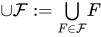
A family of sets is said to cover a set
When
A cover 
04Special types of set families
A Sperner family is a set family in which none of the sets contains any of the others. Sperner's theorem bounds the maximum size of a Sperner family.
A Helly family is a set family such that any minimal subfamily with empty intersection has bounded size. Helly's theorem states that convex sets in Euclidean spaces of bounded dimension form Helly families.
An abstract simplicial complex is a set family 
Every filter is a family of sets.
A convexity space is a set family closed under arbitrary intersections and unions of chains (with respect to the inclusion relation).
Other examples of set families are independence systems, greedoids, antimatroids, and bornological spaces.
Families of sets over 
| ||||||||||
|---|---|---|---|---|---|---|---|---|---|---|
Is necessarily true of  or, is closed under:
| Directed by 
| 
| 
| 
| 
| 
| 
| 
| 
| F.I.P. |
| π-system | ||||||||||
| Semiring | Never | |||||||||
| Semialgebra (semifield) | Never | |||||||||
| Monotone class | only if  | only if  | ||||||||
| 𝜆-system (Dynkin system) | only if | only if or they are disjoint | Never | |||||||
| Ring (order theory) | ||||||||||
| Ring (measure theory) | Never | |||||||||
| δ-ring | Never | |||||||||
| 𝜎-ring | Never | |||||||||
| Algebra (field) | Never | |||||||||
| 𝜎-algebra (𝜎-field) | Never | |||||||||
| Filter | ||||||||||
| Proper filter | Never | Never | Never | |||||||
| Prefilter (filter base) | ||||||||||
| Filter subbase | ||||||||||
| Open topology | (even arbitrary  ) ) | Never | ||||||||
| Closed topology | (even arbitrary  ) ) | Never | ||||||||
| Is necessarily true of or, is closed under:
| directed downward | finite intersections | finite unions | relative complements | complements in
| countable intersections | countable unions | contains
| contains
| Finite intersection property |
|
Additionally, a semiring is a π-system where every complement | ||||||||||

 are arbitrary elements of
Sources and credits
This article is adapted from the Wikipedia article “Family of sets”, written by its contributors and licensed under CC BY-SA 4.0. Fathomly has changed the layout, removed citation markers, navigation and maintenance notices, and adjusted punctuation. This adapted version is shared under the same license. For references, see the original article.
Fathomly is not affiliated with or endorsed by the Wikimedia Foundation. Spotted a problem? Tell us.