Indexed family
Collection of objects, associated with an index set
In mathematics, a family, or indexed family, is a collection of objects, each associated with an element, known as an index, that belongs to some index set.
For example, a family of real numbers, indexed by the set of integers, is a collection of real numbers, where a given function selects one real number for each integer (possibly the same) as indexing.
More formally, an indexed family is a mathematical function together with its domain and image
(that is, indexed families and mathematical functions are technically identical, just points of view are different). Often the elements of the set
are referred to as making up the family. In this view, an indexed family is interpreted as a collection of indexed elements, instead of a function. The set
is called the index set of the family, and
is the indexed set.
Sequences are one type of families indexed by natural numbers. In general, the index set is not restricted to be countable. For example, one could consider an uncountable family of subsets of the natural numbers indexed by the real numbers.
01Definition
Let and
be sets. A family of elements of
indexed by
, denoted
, is a function
such that
for all
. The element
is known as the term of index
.
Notation using different brackets, such as
is also valid.
Functions and indexed families are formally equivalent, since any function with a domain
induces a family
and conversely. (The terms "mapping" for functions and "indexing" for indexed families are equivalent.) Being an element of a family is equivalent to being in the range of the corresponding function. In practice, however, a family is viewed as a collection, rather than a function.
Any set gives rise to a family
where
is indexed by itself (meaning that
is the identity function). However, families differ from sets in that the same object can appear multiple times with different indices in a family, whereas a set is a collection of distinct objects. A family contains any element exactly once if and only if the corresponding function is injective.
An indexed family defines a set
that is, the image of
under
Since the mapping
is not required to be injective, there may exist
with
such that
Thus,
, where
denotes the cardinality of the set
For example, the sequence
indexed by the natural numbers
has image set
In addition, the set
does not carry information about any structures on
Hence, by using a set instead of the family, some information might be lost. For example, an ordering on the index set of a family induces an ordering on the family, but no ordering on the corresponding image set.
Indexed subfamily
An indexed family is a subfamily of an indexed family
if and only if
is a subset of
and
holds for all
02Examples
Indexed vectors
For example, consider the following sentence:
The vectors
are linearly independent.
Here denotes a family of vectors. The
-th vector
only makes sense with respect to this family, as sets are unordered so there is no
-th vector of a set. Furthermore, linear independence is defined as a property of a collection; it therefore is important if those vectors are linearly independent as a set or as a family. For example, if we consider
and
as the same vector, then the set of them consists of only one element (as a set is a collection of unordered distinct elements) and is linearly independent, but the family contains the same element twice (since indexed differently) and is linearly dependent (same vectors are linearly dependent).
Matrices
Suppose a text states the following:
A square matrix
is invertible, if and only if the rows of
are linearly independent.
As in the previous example, it is important that the rows of are linearly independent as a family, not as a set. For example, consider the matrix
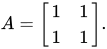
The set of the rows consists of a single element
as a set is made of unique elements so it is linearly independent, but the matrix is not invertible as the matrix determinant is 0. On the other hand, the family of the rows contains two elements indexed differently such as the 1st row
and the 2nd row
so it is linearly dependent. The statement is therefore correct if it refers to the family of rows, but wrong if it refers to the set of rows. (The statement is also correct when "the rows" is interpreted as referring to a multiset, in which the elements are also kept distinct but which lacks some of the structure of an indexed family.)
Other examples
Let be the finite set
where
is a positive integer.
- An ordered pair (2-tuple) is a family indexed by the set of two elements,
each element of the ordered pair is indexed by an element of the set
- An
-tuple is a family indexed by the set
- An infinite sequence is a family indexed by the natural numbers.
- A list is an
-tuple for an unspecified
or an infinite sequence.
- An
matrix is a family indexed by the Cartesian product
which elements are ordered pairs; for example,
indexing the matrix element at the 2nd row and the 5th column.
- A net is a family indexed by a directed set.
03Operations on indexed families
Index sets are often used in sums and other similar operations. For example, if is an indexed family of numbers, the sum of all those numbers is denoted by
When is a family of sets, the union of all those sets is denoted by
Likewise for intersections and Cartesian products.
04Usage in category theory
The analogous concept in category theory is called a diagram. A diagram is a functor giving rise to an indexed family of objects in a category C, indexed by another category J, and related by morphisms depending on two indices.
Sources and credits
This article is adapted from the Wikipedia article “Indexed family”, written by its contributors and licensed under CC BY-SA 4.0. Fathomly has changed the layout, removed citation markers, navigation and maintenance notices, and adjusted punctuation. This adapted version is shared under the same license. For references, see the original article.
Fathomly is not affiliated with or endorsed by the Wikimedia Foundation. Spotted a problem? Tell us.



