Semi-continuity
Property of functions which is weaker than continuity

In mathematical analysis, semicontinuity (or semi-continuity) is a property of extended real-valued functions that is weaker than continuity. An extended real-valued function 





A function is continuous if and only if it is both upper and lower semicontinuous. If we take a continuous function and increase its value at a certain point 


The notion of upper and lower semicontinuous function was first introduced and studied by René Baire in his thesis in 1899.
01Definitions
Assume throughout that 
![{\overline {\mathbb {R} }}=\mathbb {R} \cup \{-\infty ,\infty \}=[-\infty ,\infty ]](https://wikimedia.org/api/rest_v1/media/math/render/svg/b095388ff2cb62df5a45671a0d2dae6dd9ff4db9)
Upper semicontinuity
A function 


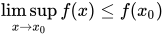

If 




A function
- (1) The function is upper semicontinuous at every point of its domain.
- (2) For each
, the set
is open in
.
- (3) For each
-superlevel set
is closed in
- (4) The hypograph
is closed in
- (5) The function
is given the left order topology. This is just a restatement of condition (2) since the left order topology is generated by all the intervals
.
Lower semicontinuity
A function 

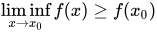


If 
A function
- (1) The function is lower semicontinuous at every point of its domain.
- (2) For each
is open in
.
- (3) For each
is closed in
- (4) The epigraph
- (5) The function
.

02Examples
Consider the function 
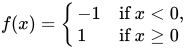

The floor function 


Upper and lower semicontinuity bear no relation to continuity from the left or from the right for functions of a real variable. Semicontinuity is defined in terms of an ordering in the range of the functions, not in the domain. For example the function
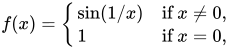

If 
![\Gamma =C([0,1],X)](https://wikimedia.org/api/rest_v1/media/math/render/svg/ec5e166b2c51fd7a377e58ccb71fd1f445fc7732)
![d_{\Gamma }(\alpha ,\beta )=\sup\{d_{X}(\alpha (t),\beta (t)):t\in [0,1]\}](https://wikimedia.org/api/rest_v1/media/math/render/svg/70a1f48434a8ad4fece85cd420bf0ddbdc767a4d)
![L:\Gamma \to [0,+\infty ],](https://wikimedia.org/api/rest_v1/media/math/render/svg/9ae1609c7c11f3aa1f8de31b212f52fb0ed747a5)


A fundamental example in real analysis is Fatou's lemma. It asserts that if 
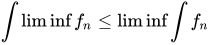


![[-\infty ,+\infty ]](https://wikimedia.org/api/rest_v1/media/math/render/svg/a7a5a5ba47896e8fdd43cf7f311db27350f0f8ff)
03Properties
Unless specified otherwise, all functions below are from a topological space ![{\overline {\mathbb {R} }}=[-\infty ,\infty ].](https://wikimedia.org/api/rest_v1/media/math/render/svg/c99d0218a0b787a96d52c204201e1c27f520914a)
- A function
- The characteristic function or indicator function of a set
(defined by
if
and
if
) is upper semicontinuous if and only if
is a closed set. It is lower semicontinuous if and only if
- In the field of convex analysis, the characteristic function of a set
if
if
Binary operations on semicontinuous functions
Let 
- If
are lower semicontinuous, then the sum
is lower semicontinuous (provided the sum is well-defined, i.e.,
is not the indeterminate form
). The same holds for upper semicontinuous functions.
- If
is lower semicontinuous. The corresponding result holds for upper semicontinuous functions.
- The function
- If
is upper semicontinuous. On the other hand, if
defined as
. Then
, which is not upper semicontinuous unless
- If
and
) are also lower semicontinuous. Consequently, the set of all lower semicontinuous functions from
) forms a lattice. The corresponding statements also hold for upper semicontinuous functions.
Optimization of semicontinuous functions
- The (pointwise) supremum of an arbitrary family
of lower semicontinuous functions
(defined by
) is lower semicontinuous.
- In particular, the limit of a monotone increasing sequence
of continuous functions is lower semicontinuous. (The Theorem of Baire below provides a partial converse.) The limit function will only be lower semicontinuous in general, not continuous. An example is given by the functions
defined for
for

- Likewise, the infimum of an arbitrary family of upper semicontinuous functions is upper semicontinuous. And the limit of a monotone decreasing sequence of continuous functions is upper semicontinuous.
- If
is a compact space (for instance a closed bounded interval
) and
is upper semicontinuous, then
If
it attains a minimum on
- (Proof for the upper semicontinuous case: By condition (5) in the definition,
is compact in that topology. And the compact sets in that topology are exactly the sets with a maximum. For an alternative proof, see the article on the extreme value theorem.)
Other properties
- (Theorem of Baire) Let
In particular, there exists a sequence
of continuous functions
and
- If
, the continuous functions can be taken to be real-valued.

- Additionally, every upper semicontinuous function
if
the continuous functions can be taken to be real-valued.
- Any upper semicontinuous function
on an arbitrary topological space
- If the topological space
is upper semi-continuous if and only if it is sequentially upper semi-continuous, that is, if for any
and any sequence
that converges towards
, there holds
. Equivalently, in a sequential space,
are sequentially closed for all
04Semicontinuity of set-valued functions
For set-valued functions, several concepts of semicontinuity have been defined, namely upper, lower, outer, and inner semicontinuity, as well as upper and lower hemicontinuity.
A set-valued function 


Upper and lower semicontinuity
A set-valued map 


A set-valued map 
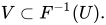
Upper and lower set-valued semicontinuity are also defined more generally for a set-valued maps between topological spaces by replacing 

Note, that there is not a direct correspondence between single-valued lower and upper semicontinuity and set-valued lower and upper semicontinuouty.
An upper semicontinuous single-valued function is not necessarily upper semicontinuous when considered as a set-valued map.
For example, the function 
Inner and outer semicontinuity
A set-valued function 


A set-valued function 


05Hulls
Because the supremum of a family of lower semicontinuous functions is lower semicontinuous, if 

The lower semicontinuous hull plays a role in convex analysis. Given a convex (extended real) function, the epigraph might not be closed. But the lower semicontinuous hull of a convex function is convex, and is known as the closure of the original convex function.
Some operations in convex analysis, such as the Legendre transform automatically produce closed convex functions. The Legendre transform applied twice to a convex function gives the closure of the original function, rather than the original function. Thus the lower semicontinuous hull is a way of regularizing convex functions, by modifying it at boundary points of its effective domain.
In categorical terms, the lower semicontinuous hull of a function 


Other types of hulls are often considered in applications. For example, the infimum of the set of continuous affine functions that majorize a given function on a convex subset of a topological vector space is upper semicontinuous. This fact is used in the proof of the Choquet theorem. Similar ideas applied to subharmonic functions are used in the Perron method for solving the Dirichlet problem for the Laplace operator in a domain. The key condition for the class of subharmonic solutions is upper semicontinuity, particularly near the boundary where the boundary conditions are applied.
06Applications
Calculus of variations
An important application of semicontinuity is to the calculus of variations. It derives its significance in this context due to the following theorem. Let ![F:X\to (-\infty ,+\infty ]](https://wikimedia.org/api/rest_v1/media/math/render/svg/d1d24deeeed09dea31c47ec03dd29a73842d5ebb)


This is often combined with results such as Tonelli's theorem in functional analysis, which characterizes the weak lower semicontinuity of nonlinear functionals on Lp spaces in terms of the convexity of another function. More specialized results of this kind are useful in variational formulations of problems in partial differential equations, which relate semicontinuity of functionals given by integration to the convexity properties of the integrand, often defined on some Sobolev space. The prototypical example is the Dirichlet problem for the Laplace operator, which can be formulated as a minimization problem of the energy, subject to boundary conditions,

Existence of saddle points
Together with convexity assumptions, both upper and lower semicontinuity play a role in theorems guaranteeing the existence of saddle points of functions, on locally convex topological vector spaces. One such result is the minimax theorem of Fan and Sion. It states that if 

is concave and upper semicontinuous for each
is convex and lower semicontinuous for each
,
then the set of saddle points of 


Dimension
Many integer-valued functions of importance are also semicontinuous. For a simple example, suppose one has a polyhedron 


Another example of a similar character is that matrix rank is a lower semicontinuous function on the space of 

Algebraic geometry
More sophisticated versions of this same idea play a fundamental role in algebraic geometry, where many dimension maps with codomain in the integers are known to be semicontinuous. (For example as applied to a Newton-Okounkov body.)
In general, let 


Let 


Vakil collected a list of further semicontinuity results in algebraic geometry.
Descriptive set theory
Semicontinuous functions are used in descriptive set theory to define stratifications of topological spaces by complexity measures such as dimension, rank, or ordinal height. Such functions often take values in an ordinal, and their semicontinuity ensures that the sets 
A central example is the rank function on well-founded trees. Let 


More generally, ordinal-valued lower semicontinuous functions are used to measure the complexity of points or structures in a Polish space, such as Scott ranks of countable structures, projective ranks of sets, or Lusin-Novikov complexities of equivalence relations. These functions enable fine classification and are crucial in defining universal sets and effective parametrizations in higher levels of the projective hierarchy.
Because the preimage of an interval ![[\alpha ,\infty ]](https://wikimedia.org/api/rest_v1/media/math/render/svg/e4d4c99f5ec3cbeef3dfd0d90a906abb2cf30337)
Dynamical systems
In ergodic theory and topological dynamics, semicontinuity arises naturally when studying functionals on the space of invariant measures of a dynamical system. The most important example is the entropy function, which assigns to each invariant measure its measure-theoretic entropy.
Let 


This property plays a key role in the variational principle, which asserts that the topological entropy 

More generally, many functionals of interest, such as Lyapunov exponents, dimension spectra, or return time statistics, are semicontinuous on the space of invariant measures. In some cases, these semicontinuity properties are used to prove existence of measures maximizing or minimizing a given quantity, or to establish structural properties of the simplex 
Similar ideas appear in the theory of joinings, where one studies invariant couplings between systems. The set of joinings is compact in the weak-* topology, and semicontinuity is used to analyze disjointness and uniqueness of invariant couplings.
Sources and credits
This article is adapted from the Wikipedia article “Semi-continuity”, written by its contributors and licensed under CC BY-SA 4.0. Fathomly has changed the layout, removed citation markers, navigation and maintenance notices, and adjusted punctuation. This adapted version is shared under the same license. For references, see the original article.
Images, from Wikimedia Commons:
- Upper semi.svg by Mktyscn, Public domain
- Lower semi.svg by Mktyscn, Public domain
Fathomly is not affiliated with or endorsed by the Wikimedia Foundation. Spotted a problem? Tell us.