Perron method
Mathematical technique
In the mathematical study of harmonic functions, the Perron method, also known as the method of subharmonic functions, is a technique introduced by Oskar Perron for the solution of the Dirichlet problem for Laplace's equation. The Perron method works by finding the largest subharmonic function with boundary values below the desired values; the "Perron solution" coincides with the actual solution of the Dirichlet problem if the problem is soluble.
The Dirichlet problem is to find a harmonic function in a domain, with boundary conditions given by a continuous function 

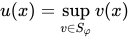
where 
The Perron solution u(x) is always harmonic; however, the values it takes on the boundary may not be the same as the desired boundary values 



The characterization of regular points on surfaces is part of potential theory. Regular points on the boundary of a domain 


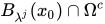

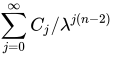
diverges.
The Wiener criterion was first devised by Norbert Wiener; it was extended by Werner Püschel to uniformly elliptic divergence-form equations with smooth coefficients, and thence to uniformly elliptic divergence form equations with bounded measureable coefficients by Walter Littman, Guido Stampacchia, and Hans Weinberger.
Sources and credits
This article is adapted from the Wikipedia article “Perron method”, written by its contributors and licensed under CC BY-SA 4.0. Fathomly has changed the layout, removed citation markers, navigation and maintenance notices, and adjusted punctuation. This adapted version is shared under the same license. For references, see the original article.
Fathomly is not affiliated with or endorsed by the Wikimedia Foundation. Spotted a problem? Tell us.