Pointwise
Applying operations to functions in terms of values for each input "point"
In mathematics, the qualifier pointwise is used to indicate that a certain property is defined by considering each value 

01Pointwise operations
Formal definition
A binary operation o: Y × Y → Y on a set Y can be lifted pointwise to an operation O: (X→Y) × (X→Y) → (X→Y) on the set X → Y of all functions from X to Y as follows: Given two functions f1: X → Y and f2: X → Y, define the function O(f1, f2): X → Y by
(O(f1, f2))(x) = o(f1(x), f2(x)) for all x ∈ X.Commonly, o and O are denoted by the same symbol. A similar definition is used for unary operations o, and for operations of other arity.
Examples
The pointwise addition 



The pointwise product or pointwise multiplication is:

The pointwise product with a scalar is usually written with the scalar term first. Thus, when 

An example of an operation on functions which is not pointwise is convolution.
Properties
Pointwise operations inherit such properties as associativity, commutativity and distributivity from corresponding operations on the codomain.
If 


02Componentwise operations
Componentwise operations are usually defined on vectors, where vectors are elements of the set 



Componentwise operations can be defined on matrices. Matrix addition, where 
A tuple can be regarded as a function, and a vector is a tuple. Therefore, any vector 

03Pointwise relations
In order theory it is common to define a pointwise partial order on functions. With A, B posets, the set of functions A → B can be ordered by defining f ≤ g if (∀x ∈ A) f(x) ≤ g(x). Pointwise orders also inherit some properties of the underlying posets. For instance if A and B are continuous lattices, then so is the set of functions A → B with pointwise order. Using the pointwise order on functions one can concisely define other important notions, for instance:
- A closure operator c on a poset P is a monotone and idempotent self-map on P (i.e. a projection operator) with the additional property that idA ≤ c, where id is the identity function.
- Similarly, a projection operator k is called a kernel operator if and only if k ≤ idA.
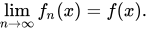
An example of an infinitary pointwise relation is pointwise convergence of functions, a sequence of functions


Sources and credits
This article is adapted from the Wikipedia article “Pointwise”, written by its contributors and licensed under CC BY-SA 4.0. Fathomly has changed the layout, removed citation markers, navigation and maintenance notices, and adjusted punctuation. This adapted version is shared under the same license. For references, see the original article.
Images, from Wikimedia Commons:
- Pointwise sum and product of sin and ln function.png by Jochen Burghardt, CC BY-SA 4.0
Fathomly is not affiliated with or endorsed by the Wikimedia Foundation. Spotted a problem? Tell us.