Random measure
Stochastic way of assigning quantities across a space
In probability theory, a random measure is a measure-valued random element. Random measures are for example used in the theory of random processes, where they form many important point processes such as Poisson point processes and Cox processes.
01Definition
Random measures can be defined as transition kernels or as random elements. Both definitions are equivalent. For the definitions, let 


As a transition kernel
A random measure 


Being a transition kernel means that
- For any fixed
, the mapping
- is measurable from
to


- For every fixed
, the mapping
- is a measure on

Being locally finite means that the measures
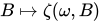
satisfy 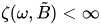


In the context of stochastic processes there is the related concept of a stochastic kernel, probability kernel, Markov kernel.
As a random element
Define

and the subset of locally finite measures by

For all bounded measurable 
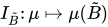
from 


A random measure is a random element from 

02Basic related concepts
Intensity measure
For a random measure 
![\operatorname {E} \left[\int f(x)\;\zeta (\mathrm {d} x)\right]=\int f(x)\;\operatorname {E} \zeta (\mathrm {d} x)](https://wikimedia.org/api/rest_v1/media/math/render/svg/7da0659cf22a04c804da5ccb36f5e0d8bb90f8ef)
for every positive measurable function 
Supporting measure
For a random measure 

for all positive measurable functions is called the supporting measure of
Laplace transform
For a random measure
![{\mathcal {L}}_{\zeta }(f)=\operatorname {E} \left[\exp \left(-\int f(x)\;\zeta (\mathrm {d} x)\right)\right]](https://wikimedia.org/api/rest_v1/media/math/render/svg/68953540667c5a207e052251d944bb9bab578672)
for every positive measurable function
03Basic properties
Measurability of integrals
For a random measure
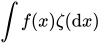
and
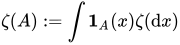
for positive
Uniqueness
The distribution of a random measure is uniquely determined by the distributions of
for all continuous functions with compact support 


Decomposition
A measure generally might be decomposed as:
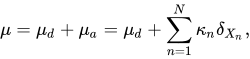
Here 

04Random counting measure
A random measure of the form:
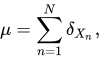
where 

In the formal notation of above a random counting measure is a map from a probability space to the measurable space (


The definitions of expectation measure, Laplace functional, moment measures and stationarity for random measures follow those of point processes. Random measures are useful in the description and analysis of Monte Carlo methods, such as Monte Carlo numerical quadrature and particle filters.
Sources and credits
This article is adapted from the Wikipedia article “Random measure”, written by its contributors and licensed under CC BY-SA 4.0. Fathomly has changed the layout, removed citation markers, navigation and maintenance notices, and adjusted punctuation. This adapted version is shared under the same license. For references, see the original article.
Fathomly is not affiliated with or endorsed by the Wikimedia Foundation. Spotted a problem? Tell us.