Null set
Measurable set whose measure is zero

In mathematical analysis, a null set in 
A null set is not to be confused with the empty set as defined in set theory. Although the empty set has Lebesgue measure zero, there are also non-empty sets which are null. For example, any non-empty countable set of real numbers has Lebesgue measure zero and therefore is null.
More generally, on a given measure space 


01Examples
Every finite or countably infinite subset of the real numbers 


The Cantor set is an example of an uncountable null set. It is uncountable because it contains all real numbers between 0 and 1 whose ternary expansion can be written using only 0s and 2s (see Cantor's diagonal argument), and it is null because it is constructed by beginning with the closed interval of real numbers from 0 to 1 and iteratively removing a third of the previous set, thereby multiplying the length by 2/3 with every step.
The set of Liouville numbers is another example of an uncountable null set.
02Definition for Lebesgue measure
The Lebesgue measure is the standard way of assigning a length, area or volume to subsets of Euclidean space.
A subset 
 there is a sequence
  of intervals in (where interval
  has length
  ) such that is contained in the union of the and the total length of the union is less than
  i.e.,
i.e., 
(In terminology of mathematical analysis, this definition requires that there be a sequence of open covers of 
This condition can be generalised to 

For instance:
- With respect to
- The standard construction of the Cantor set is an example of a null uncountable set in
however other constructions are possible which assign the Cantor set any measure whatsoever.
- All the subsets of
whose dimension is smaller than
For instance straight lines or circles are null sets in
- Sard's lemma: the set of critical values of a smooth function has measure zero.


If 


- For
and


03Measure-theoretic properties
Let 
(by definition of
).
- Any countable union of null sets is itself a null set (by countable subadditivity of
- Any (measurable) subset of a null set is itself a null set (by monotonicity of
Together, these facts show that the null sets of 
04Uses
Null sets play a key role in the definition of the Lebesgue integral: if functions 


A measure in which all subsets of null sets are measurable is complete. Any non-complete measure can be completed to form a complete measure by asserting that subsets of null sets have measure zero. Lebesgue measure is an example of a complete measure; in some constructions, it is defined as the completion of a non-complete Borel measure.
A subset of the Cantor set which is not Borel measurable
The Borel measure is not complete. One simple construction is to start with the standard Cantor set 


First, we have to know that every set of positive measure contains a nonmeasurable subset. Let 
![[0,1],](https://wikimedia.org/api/rest_v1/media/math/render/svg/971caee396752d8bf56711f55d2c3b1207d4a236)





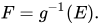




05Haar null sets
In a separable Banach space 


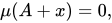
The term refers to the null invariance of the measures of translates, associating it with the complete invariance found with Haar measure.
Some algebraic properties of topological groups have been related to the size of subsets and Haar null sets.
Haar null sets have been used in Polish groups to show that when A is not a meagre set then 
Sources and credits
This article is adapted from the Wikipedia article “Null set”, written by its contributors and licensed under CC BY-SA 4.0. Fathomly has changed the layout, removed citation markers, navigation and maintenance notices, and adjusted punctuation. This adapted version is shared under the same license. For references, see the original article.
Images, from Wikimedia Commons:
- Sierpinski triangle.svg by Unknown author, CC BY-SA 3.0
Fathomly is not affiliated with or endorsed by the Wikimedia Foundation. Spotted a problem? Tell us.