Transition kernel
Mathematical function
In the mathematics of probability, a transition kernel or kernel is a function in mathematics that has different applications. Kernels can for example be used to define random measures or stochastic processes. The most important example of kernels are the Markov kernels.
01Definition
Let 

![\kappa \colon S\times {\mathcal {T}}\to [0,+\infty ]](https://wikimedia.org/api/rest_v1/media/math/render/svg/f2f6d48846ae254d72ea28a3cab412fc1cdc64ad)
is called a (transition) kernel from 

- For any fixed
, the mapping
- is
-measurable;

- For every fixed
, the mapping
- is a measure on

02Classification of transition kernels
Transition kernels are usually classified by the measures they define. Those measures are defined as
![\kappa _{s}\colon {\mathcal {T}}\to [0,+\infty ]](https://wikimedia.org/api/rest_v1/media/math/render/svg/f2c9e70c6ccefbfe3b000ff697c3b6ed37bd8705)
with

for all 
- a substochastic kernel, sub-probability kernel or a sub-Markov kernel if all
are sub-probability measures
- a Markov kernel, stochastic kernel or probability kernel if all
- a finite kernel if all
- a
-finite kernel if all
- a
-finite kernel if
- a uniformly
in
for all
.
03Operations
In this section, let 


Product of kernels
Definition
Let 


![\kappa ^{1}\otimes \kappa ^{2}\colon S\times ({\mathcal {T}}\otimes {\mathcal {U}})\to [0,\infty ]](https://wikimedia.org/api/rest_v1/media/math/render/svg/51d3de728ea12c25432c0e4ecd06b73a4159d6a5)

for all 
Properties and comments
The product of two kernels is a kernel from 

for any three suitable s-finite kernels 
The product is also well-defined if

for all 
Composition of kernels
Definition
Let 
![\kappa ^{1}\cdot \kappa ^{2}\colon S\times {\mathcal {U}}\to [0,\infty ]](https://wikimedia.org/api/rest_v1/media/math/render/svg/e3103d9518c0ece3de6fbf016f6972d5d2b984dd)

for all 
Properties and comments
The composition is a kernel from

for any three suitable s-finite kernels
An alternative notation is for the composition is

04Kernels as operators
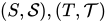
Let 
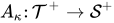
Every kernel
given by
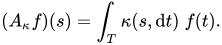
The composition of these operators is compatible with the composition of kernels, meaning

Sources and credits
This article is adapted from the Wikipedia article “Transition kernel”, written by its contributors and licensed under CC BY-SA 4.0. Fathomly has changed the layout, removed citation markers, navigation and maintenance notices, and adjusted punctuation. This adapted version is shared under the same license. For references, see the original article.
Fathomly is not affiliated with or endorsed by the Wikimedia Foundation. Spotted a problem? Tell us.