Reference articles on history, science, culture and more
Encyclopedia

Q-gamma function

Function in q-analog theory

In q-analog theory, the q-gamma function, or basic gamma function, is a generalization of the ordinary gamma function closely related to the double gamma function. It was introduced by Jackson (1905). It is given by \Gamma _{q}(x)=(1-q)^{1-x}\prod _{n=0}^{\infty }{\frac {1-q^{n+1}}{1-q^{n+x}}}=(1-q)^{1-x}\,{\frac {(q;q)_{\infty }}{(q^{x};q)_{\infty }}} when |q|<1, and \Gamma _{q}(x)={\frac {(q^{-1};q^{-1})_{\infty }}{(q^{-x};q^{-1})_{\infty }}}(q-1)^{1-x}q^{\binom {x}{2}} if |q|>1. Here (\cdot ;\cdot )_{\infty } is the infinite q-Pochhammer symbol. The q-gamma function satisfies the functional equation \Gamma _{q}(x+1)={\frac {1-q^{x}}{1-q}}\Gamma _{q}(x)=[x]_{q}\Gamma _{q}(x) In addition, the q-gamma function satisfies the q-analog of the Bohr-Mollerup theorem, which was found by Richard Askey (Askey (1978)).

For non-negative integers n, \Gamma _{q}(n)=[n-1]_{q}! where [\cdot ]_{q} is the q-factorial function. Thus the q-gamma function can be considered as an extension of the q-factorial function to the real numbers.

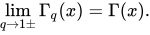
The relation to the ordinary gamma function is made explicit in the limit \lim _{q\to 1\pm }\Gamma _{q}(x)=\Gamma (x). There is a simple proof of this limit by Gosper. See the appendix of (Andrews (1986)).
01Transformation properties

The q-gamma function satisfies the q-analog of the Gauss multiplication formula (Gasper & Rahman (2004)): \Gamma _{q}(nx)\Gamma _{r}(1/n)\Gamma _{r}(2/n)\cdots \Gamma _{r}((n-1)/n)=\left({\frac {1-q^{n}}{1-q}}\right)^{nx-1}\Gamma _{r}(x)\Gamma _{r}(x+1/n)\cdots \Gamma _{r}(x+(n-1)/n),\ r=q^{n}.

Integral representation

The q-gamma function has the following integral representation (Ismail (1981)): {\frac {1}{\Gamma _{q}(z)}}={\frac {\sin(\pi z)}{\pi }}\int _{0}^{\infty }{\frac {t^{-z}\mathrm {d} t}{(-t(1-q);q)_{\infty }}}.

Stirling formula

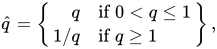
Moak obtained the following q-analogue of the Stirling formula (see Moak (1984)): \log \Gamma _{q}(x)\sim (x-1/2)\log[x]_{q}+{\frac {\mathrm {Li} _{2}(1-q^{x})}{\log q}}+C_{\hat {q}}+{\frac {1}{2}}H(q-1)\log q+\sum _{k=1}^{\infty }{\frac {B_{2k}}{(2k)!}}\left({\frac {\log {\hat {q}}}{{\hat {q}}^{x}-1}}\right)^{2k-1}{\hat {q}}^{x}p_{2k-3}({\hat {q}}^{x}),\ x\to \infty , {\hat {q}}=\left\{{\begin{aligned}q\quad \mathrm {if} \ &0<q\leq 1\\1/q\quad \mathrm {if} \ &q\geq 1\end{aligned}}\right\}, C_{q}={\frac {1}{2}}\log(2\pi )+{\frac {1}{2}}\log \left({\frac {q-1}{\log q}}\right)-{\frac {1}{24}}\log q+\log \sum _{m=-\infty }^{\infty }\left(r^{m(6m+1)}-r^{(3m+1)(2m+1)}\right), where r=\exp(4\pi ^{2}/\log q), H denotes the Heaviside step function, B_{k} stands for the Bernoulli number, \mathrm {Li} _{2}(z) is the dilogarithm, and p_{k} is a polynomial of degree k satisfying p_{k}(z)=z(1-z)p'_{k-1}(z)+(kz+1)p_{k-1}(z),p_{0}=p_{-1}=1,k=1,2,\cdots .

02Raabe-type formulas

Due to I. Mező, the q-analogue of the Raabe formula exists, at least if we use the q-gamma function when |q|>1. With this restriction, \int _{0}^{1}\log \Gamma _{q}(x)dx={\frac {\zeta (2)}{\log q}}+\log {\sqrt {\frac {q-1}{\sqrt[{6}]{q}}}}+\log(q^{-1};q^{-1})_{\infty }\quad (q>1). El Bachraoui considered the case 0<q<1 and proved that \int _{0}^{1}\log \Gamma _{q}(x)dx={\frac {1}{2}}\log(1-q)-{\frac {\zeta (2)}{\log q}}+\log(q;q)_{\infty }\quad (0<q<1).

03Special values

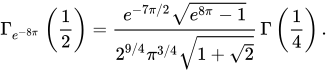
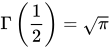
The following special values are known. \Gamma _{e^{-\pi }}\left({\frac {1}{2}}\right)={\frac {e^{-7\pi /16}{\sqrt {e^{\pi }-1}}{\sqrt[{4}]{1+{\sqrt {2}}}}}{2^{15/16}\pi ^{3/4}}}\,\Gamma \left({\frac {1}{4}}\right), \Gamma _{e^{-2\pi }}\left({\frac {1}{2}}\right)={\frac {e^{-7\pi /8}{\sqrt {e^{2\pi }-1}}}{2^{9/8}\pi ^{3/4}}}\,\Gamma \left({\frac {1}{4}}\right), \Gamma _{e^{-4\pi }}\left({\frac {1}{2}}\right)={\frac {e^{-7\pi /4}{\sqrt {e^{4\pi }-1}}}{2^{7/4}\pi ^{3/4}}}\,\Gamma \left({\frac {1}{4}}\right), \Gamma _{e^{-8\pi }}\left({\frac {1}{2}}\right)={\frac {e^{-7\pi /2}{\sqrt {e^{8\pi }-1}}}{2^{9/4}\pi ^{3/4}{\sqrt {1+{\sqrt {2}}}}}}\,\Gamma \left({\frac {1}{4}}\right). These are the analogues of the classical formula \Gamma \left({\frac {1}{2}}\right)={\sqrt {\pi }}.

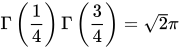
Moreover, the following analogues of the familiar identity \Gamma \left({\frac {1}{4}}\right)\Gamma \left({\frac {3}{4}}\right)={\sqrt {2}}\pi hold true: \Gamma _{e^{-2\pi }}\left({\frac {1}{4}}\right)\Gamma _{e^{-2\pi }}\left({\frac {3}{4}}\right)={\frac {e^{-29\pi /16}\left(e^{2\pi }-1\right){\sqrt[{4}]{1+{\sqrt {2}}}}}{2^{33/16}\pi ^{3/2}}}\,\Gamma \left({\frac {1}{4}}\right)^{2}, \Gamma _{e^{-4\pi }}\left({\frac {1}{4}}\right)\Gamma _{e^{-4\pi }}\left({\frac {3}{4}}\right)={\frac {e^{-29\pi /8}\left(e^{4\pi }-1\right)}{2^{23/8}\pi ^{3/2}}}\,\Gamma \left({\frac {1}{4}}\right)^{2}, \Gamma _{e^{-8\pi }}\left({\frac {1}{4}}\right)\Gamma _{e^{-8\pi }}\left({\frac {3}{4}}\right)={\frac {e^{-29\pi /4}\left(e^{8\pi }-1\right)}{16\pi ^{3/2}{\sqrt {1+{\sqrt {2}}}}}}\,\Gamma \left({\frac {1}{4}}\right)^{2}.
04Matrix version

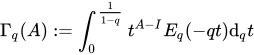
Let A be a complex square matrix and positive-definite matrix. Then a q-gamma matrix function can be defined by q-integral: \Gamma _{q}(A):=\int _{0}^{\frac {1}{1-q}}t^{A-I}E_{q}(-qt)\mathrm {d} _{q}t where E_{q} is the q-exponential function.

05Other q-gamma functions

For other q-gamma functions, see Yamasaki 2006.

06Numerical computation

An iterative algorithm to compute the q-gamma function was proposed by Gabutti and Allasia.

Watch videos about Q-gamma functionExplainers and documentaries on YouTube (opens in a new tab)

Sources and credits

This article is adapted from the Wikipedia article Q-gamma function, written by its contributors and licensed under CC BY-SA 4.0. Fathomly has changed the layout, removed citation markers, navigation and maintenance notices, and adjusted punctuation. This adapted version is shared under the same license. For references, see the original article.

Fathomly is not affiliated with or endorsed by the Wikimedia Foundation. Spotted a problem? Tell us.