Reference articles on history, science, culture and more
Encyclopedia

Pure submodule

Module components with flexibility in module theory

In mathematics, especially in the field of module theory, the concept of pure submodule provides a generalization of direct summand, a type of particularly well-behaved piece of a module. Pure modules are complementary to flat modules and generalize Prüfer's notion of pure subgroups. While flat modules are those modules which leave short exact sequences exact after tensoring, a pure submodule defines a short exact sequence (known as a pure exact sequence) that remains exact after tensoring with any module. Similarly a flat module is a direct limit of projective modules, and a pure exact sequence is a direct limit of split exact sequences.

01Definition

Let R be a ring (associative, with 1), let M be a (left) module over R, and let P be a submodule of M with \iota \colon P\hookrightarrow M be the natural injective map. Then P is a pure submodule of M if, for any (right) R-module X, the natural induced map \mathrm {id} _{X}\otimes _{R}\iota \colon X\otimes _{R}P\to X\otimes _{R}M is injective.

Analogously, a short exact sequence

0\longrightarrow A\,\ {\stackrel {f}{\longrightarrow }}\ B\,\ {\stackrel {g}{\longrightarrow }}\ C\longrightarrow 0

of (left) R-modules is pure exact if the sequence stays exact when tensored with any (right) R-module X. This is equivalent to saying that f(A) is a pure submodule of B.

02Equivalent characterizations

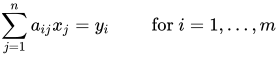
Purity of a submodule can also be expressed element-wise; it is really a statement about the solvability of certain systems of linear equations. Specifically, P is pure in M if and only if the following condition holds: for any m-by-n matrix (a_{ij}) with entries in R, and any set y_{1},\cdots ,y_{m} of elements of P, if there exist elements x_{1},\cdots ,x_{n} in M such that

\sum _{j=1}^{n}a_{ij}x_{j}=y_{i}\qquad {\mbox{ for }}i=1,\ldots ,m

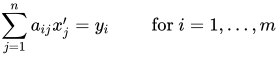
then there also exist elements x'_{1},\cdots ,x'_{n} in P such that

\sum _{j=1}^{n}a_{ij}x'_{j}=y_{i}\qquad {\mbox{ for }}i=1,\ldots ,m

Another characterization is: a sequence is pure exact if and only if it is the filtered colimit (also known as direct limit) of split exact sequences

0\longrightarrow A_{i}\longrightarrow B_{i}\longrightarrow C_{i}\longrightarrow 0.

03Examples

04Properties

Suppose 0\longrightarrow A\,\ {\stackrel {f}{\longrightarrow }}\ B\,\ {\stackrel {g}{\longrightarrow }}\ C\longrightarrow 0 is a short exact sequence of R-modules, then:

  1. C is a flat module if and only if the exact sequence is pure exact for every A and B. From this we can deduce that over a von Neumann regular ring, every submodule of every R-module is pure. This is because every module over a von Neumann regular ring is flat. The converse is also true.
  2. Suppose B is flat. Then the sequence is pure exact if and only if C is flat. From this one can deduce that pure submodules of flat modules are flat.
  3. Suppose C is flat. Then B is flat if and only if A is flat.

If 0\longrightarrow A\,\ {\stackrel {f}{\longrightarrow }}\ B\,\ {\stackrel {g}{\longrightarrow }}\ C\longrightarrow 0 is pure-exact, and F is a finitely presented R-module, then every homomorphism from F to C can be lifted to B, i.e. to every u\colon F\to C there exists v\colon F\to B such that gv=u.

Watch videos about Pure submoduleExplainers and documentaries on YouTube (opens in a new tab)

Sources and credits

This article is adapted from the Wikipedia article Pure submodule, written by its contributors and licensed under CC BY-SA 4.0. Fathomly has changed the layout, removed citation markers, navigation and maintenance notices, and adjusted punctuation. This adapted version is shared under the same license. For references, see the original article.

Fathomly is not affiliated with or endorsed by the Wikimedia Foundation. Spotted a problem? Tell us.