Projective object
Type of object in category theory
In category theory, the notion of a projective object generalizes the notion of a projective module. Projective objects in abelian categories are used in homological algebra. The dual notion of a projective object is that of an injective object.
01Definition
An object 


That is, every morphism 

If C is locally small, i.e., in particular 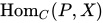

preserves epimorphisms.
Projective objects in abelian categories
If the category C is an abelian category such as, for example, the category of abelian groups, then P is projective if and only if

is an exact functor, where Ab is the category of abelian groups.
An abelian category 


The purpose of this definition is to ensure that any object A admits a projective resolution, i.e., a (long) exact sequence

where the objects 
Projectivity with respect to restricted classes
Semadeni (1963) discusses the notion of projective (and dually injective) objects relative to a so-called bicategory, which consists of a pair of subcategories of "injections" and "surjections" in the given category C. These subcategories are subject to certain formal properties including the requirement that any surjection is an epimorphism. A projective object (relative to the fixed class of surjections) is then an object P so that Hom(P, −) turns the fixed class of surjections (as opposed to all epimorphisms) into surjections of sets (in the usual sense).
02Properties
03Examples
The statement that all sets are projective is equivalent to the axiom of choice.
The projective objects in the category of abelian groups are the free abelian groups.
Let 
The category of left (right) 


The projective objects in the category of compact Hausdorff spaces are precisely the extremally disconnected spaces. This result is due to Gleason (1958), with a simplified proof given by Rainwater (1959).
In the category of Banach spaces and contractions (i.e., functionals whose norm is at most 1), the epimorphisms are precisely the maps with dense image. Wiweger (1969) harvtxt error: no target: CITEREFWiweger1969 (help) shows that the zero space is the only projective object in this category. There are non-trivial spaces, though, which are projective with respect to the class of surjective contractions. In the category of normed vector spaces with contractions (and surjective maps as "surjections"), the projective objects are precisely the 

Sources and credits
This article is adapted from the Wikipedia article “Projective object”, written by its contributors and licensed under CC BY-SA 4.0. Fathomly has changed the layout, removed citation markers, navigation and maintenance notices, and adjusted punctuation. This adapted version is shared under the same license. For references, see the original article.
Fathomly is not affiliated with or endorsed by the Wikimedia Foundation. Spotted a problem? Tell us.