Injective object
Mathematical object in category theory
In mathematics, especially in the field of category theory, the concept of injective object is a generalization of the concept of injective module. This concept is important in cohomology, in homotopy theory and in the theory of model categories. The dual notion is that of a projective object.
01Definition
An object 


That is, every morphism 

The morphism 

In a locally small category, it is equivalent to require that the hom functor 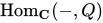

02In Abelian categories
The notion of injectivity was first formulated for abelian categories, and this is still one of its primary areas of application. When
If 
03Enough injectives and injective hulls
The category
A monomorphism g in
If g is an essential monomorphism with domain X and an injective codomain G, then G is called an injective hull of X. The injective hull is then uniquely determined by X up to a non-canonical isomorphism.
04Examples
- In the category of abelian groups and group homomorphisms, Ab, an injective object is necessarily a divisible group. Assuming the axiom of choice, the notions are equivalent.
- In the category of (left) modules and module homomorphisms, R-Mod, an injective object is an injective module. R-Mod has injective hulls (as a consequence, R-Mod has enough injectives).
- In the category of metric spaces, Met, an injective object is an injective metric space, and the injective hull of a metric space is its tight span.
- In the category of T0 spaces and continuous mappings, an injective object is always a Scott topology on a continuous lattice, and therefore it is always sober and locally compact.
05Uses
If an abelian category has enough injectives, we can form injective resolutions, i.e. for a given object X we can form a long exact sequence

and one can then define the derived functors of a given functor F by applying F to this sequence and computing the homology of the resulting (not necessarily exact) sequence. This approach is used to define Ext, and Tor functors and also the various cohomology theories in group theory, algebraic topology and algebraic geometry. The categories being used are typically functor categories or categories of sheaves of OX modules over some ringed space (X, OX) or, more generally, any Grothendieck category.
06Generalization
Let 
An object 


If
The category
A
If g is a
Examples of H-injective objects
- In the category of simplicial sets, the injective objects with respect to the class
- In the category of partially ordered sets and monotone maps, the complete lattices form the injective objects for the class
Sources and credits
This article is adapted from the Wikipedia article “Injective object”, written by its contributors and licensed under CC BY-SA 4.0. Fathomly has changed the layout, removed citation markers, navigation and maintenance notices, and adjusted punctuation. This adapted version is shared under the same license. For references, see the original article.
Images, from Wikimedia Commons:
- Diagrammadefinizionemoduloiniettivo.png by Damiano Fulghesu, Public domain
Fathomly is not affiliated with or endorsed by the Wikimedia Foundation. Spotted a problem? Tell us.