Kan fibration
Map between simplicial sets with lifting property
In mathematics, Kan complexes and Kan fibrations are part of the theory of simplicial sets. Kan fibrations are the fibrations of the standard model category structure on simplicial sets and are therefore of fundamental importance. Kan complexes are the fibrant objects in this model category. The name is in honor of Daniel Kan.
For various kinds of fibrations for simplicial sets, see Fibration of simplicial sets.
01Definitions
Definition of the standard n-simplex
For each n ≥ 0, recall that the standard 

![\Delta ^{n}(i)=\mathrm {Hom} _{\mathbf {\Delta } }([i],[n])](https://wikimedia.org/api/rest_v1/media/math/render/svg/175710077aaf17474f1a9d89e175e523e3b970c5)
Applying the geometric realization functor to this simplicial set gives a space homeomorphic to the topological standard 

Definition of a horn
For each k ≤ n, this has a subcomplex 


correspond to collections of 


for all
with
.
These conditions are satisfied for the
Definition of a Kan fibration
A map of simplicial sets 


Technical remarks
Using the correspondence between 
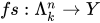


Kan complexes defined from Kan fibrations
A simplicial set 


for the inclusion map 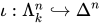

02Examples
Simplicial sets from singular homology
An important example comes from the construction of singular simplices used to define singular homology, called the singular functor pg 7
.
Given a space

Taking the set of these maps for all non-negative
.
To make this into a simplicial set, define face maps 

and degeneracy maps 
.
Since the union of any 


Relation with geometric realization
It is worth noting the singular functor is right adjoint to the geometric realization functor

giving the isomorphism

See also: Milnor's theorem on Kan complexes.
Simplicial sets underlying simplicial groups
It can be shown that the simplicial set underlying a simplicial group is always fibrant pg 12. In particular, for a simplicial abelian group, its geometric realization is homotopy equivalent to a product of Eilenberg-Maclane spaces
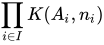
In particular, this includes classifying spaces. So the spaces 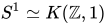


Geometric realizations of small groupoids
Another important source of examples are the simplicial sets associated to a small groupoid 
![[\Delta ^{op},{\mathcal {G}}]](https://wikimedia.org/api/rest_v1/media/math/render/svg/2ed53d8cf52160b6897180c6e6f4a96f5038e626)

Mapping space
Let 


Postnikov section
Let X be a Kan complex. Then the n-th Postnikov section 


is a Kan fibration.
- The induced map
is an isomorphism for
and for each
and choice of a base point on X.
for each
and choice of a base point on X.
For a simplicial set X, we then let 

Non-example: standard n-simplex
It turns out the standard 

![{\begin{matrix}[0,2]\mapsto [0,0]&[0,1]\mapsto [0,1]\end{matrix}}](https://wikimedia.org/api/rest_v1/media/math/render/svg/437e3556dcfe5fcbb03a2c8206710e422b3505db)
gives a counter example since it cannot be extended to a map 

but this isn't a map of simplicial sets.
03Categorical properties
Simplicial enrichment and function complexes
For simplicial sets 


and for an ordinal map ![\theta :[m]\to [n]](https://wikimedia.org/api/rest_v1/media/math/render/svg/5a83b931a8ab19c5cda2d0255ae6d2955296360c)

(since the first factor of Hom is contravariant) defined by sending a map 

Exponential law
This complex has the following exponential law of simplicial sets

which sends a map 

where 
![\iota _{n}\in {\text{Hom}}_{\Delta }([n],[n])](https://wikimedia.org/api/rest_v1/media/math/render/svg/b40625e014639754eaa631c71a36cb9333564876)
Kan fibrations and pull-backs
Given a (Kan) fibration 


(where 
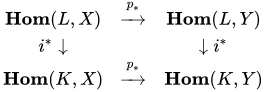
where 



The above is a consequence of a theorem of Gabriel and Zisman.

04Homotopy groups of Kan complexes
The homotopy groups of a fibrant simplicial set may be defined combinatorially, using horns, in a way that agrees with the homotopy groups of the topological space which realizes it. For a Kan complex 


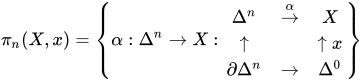
Notice the fact 



Defining the group structure requires a little more work. Essentially, given two maps 





![[x]](https://wikimedia.org/api/rest_v1/media/math/render/svg/07548563c21e128890501e14eb7c80ee2d6fda4d)
Homotopy groups of simplicial sets
Using model categories, any simplicial set 

where 
05Kan
Kan complexes themselves form a weak Kan complex called Kan. Namely, first consider the category K where objects are Kan complexes and morphisms maps of simplicial sets. As a category of presheaves has internal Hom, each hom-set in K has a structure of a simplicial set; in short, K is a simplicial category. The homotopy coherent nerve of it

is then a weak Kan complex (∞-category). In view of homotopy hypothesis, it is often taken as the ∞-category of spaces = ∞-groupoids and is also denoted as 
See also: universal left fibration.
Sources and credits
This article is adapted from the Wikipedia article “Kan fibration”, written by its contributors and licensed under CC BY-SA 4.0. Fathomly has changed the layout, removed citation markers, navigation and maintenance notices, and adjusted punctuation. This adapted version is shared under the same license. For references, see the original article.
Images, from Wikimedia Commons:
- 2dKanFibration.svg by Rswarbrick, CC BY-SA 3.0
- Kan fibration.png by Jakob.scholbach at Wikipedia, CC BY-SA 3.0
Fathomly is not affiliated with or endorsed by the Wikimedia Foundation. Spotted a problem? Tell us.