Probability generating function
Power series derived from a discrete probability distribution
In probability theory, the probability generating function of a discrete random variable is a power series representation (the generating function) of the probability mass function of the random variable. Probability generating functions are often employed for their succinct description of the sequence of probabilities Pr(X = i) in the probability mass function for a random variable X, and to make available the well-developed theory of power series with non-negative coefficients.
01Definition
Univariate case
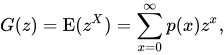
If X is a discrete random variable taking values x in the non-negative integers {0,1, ...}, then the probability generating function of X is defined as


Multivariate case
If X = (X1,...,Xd) is a discrete random variable taking values (x1, ..., xd) in the d-dimensional non-negative integer lattice {0,1, ...}d, then the probability generating function of X is defined as



02Properties
Power series
Probability generating functions obey all the rules of power series with non-negative coefficients. In particular, 

Probabilities and expectations
The following properties allow the derivation of various basic quantities related to
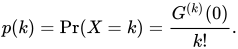
- The probability mass function of
,
- It follows from Property 1 that if random variables
have probability generating functions that are equal,
, then
. That is, if
- The normalization of the probability mass function can be expressed in terms of the generating function by
The expectation of
More generally, the
factorial moment,
of
So the variance of
Finally, the k-th raw moment of X is given by
where X is a random variable,
is the probability generating function (of
is the moment-generating function (of
![\operatorname {E} [X^{k}]=\left(z{\frac {\partial }{\partial z}}\right)^{k}G(z){\Big |}_{z=1^{-}}](https://wikimedia.org/api/rest_v1/media/math/render/svg/31e75bd0711e82a0772c01f373f1fbdf093fce58)
Functions of independent random variables
Probability generating functions are particularly useful for dealing with functions of independent random variables. For example:
- If
is a sequence of independent (and not necessarily identically distributed) random variables that take on natural-number values, and
where the
are constant natural numbers, then the probability generating function is given by
- In particular, if
and
- In the above, the number
of independent random variables in the sequence is fixed. Assume
, and consider the probability generating function
. If the
, then
This can be seen, using the law of total expectation, as follows:
This last fact is useful in the study of Galton-Watson processes and compound Poisson processes.
- When the
where
For identically distributed
by means of generating functions.


03Examples
- The probability generating function of an almost surely constant random variable, i.e. one with
and
is
- The probability generating function of a binomial random variable, the number of successes in
trials, with probability
Note: it is the
So the probability generating function of a fair coin, is - The probability generating function of a negative binomial random variable on
, the number of failures until the
success with probability of success in each trial
which converges for
.
Note that this is the-fold product of the probability generating function of a geometric random variable with parameter
on
.
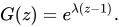
- The probability generating function of a Poisson random variable with rate parameter
is


04Related concepts
The probability generating function is an example of a generating function of a sequence: see also formal power series. It is equivalent to, and sometimes called, the z-transform of the probability mass function.
Other generating functions of random variables include the moment-generating function, the characteristic function and the cumulant generating function. The probability generating function is also equivalent to the factorial moment generating function, which as ![\operatorname {E} \left[z^{X}\right]](https://wikimedia.org/api/rest_v1/media/math/render/svg/3bf9c3fd603e9f2eea52671e6af913e4ddb6276f)
Sources and credits
This article is adapted from the Wikipedia article “Probability generating function”, written by its contributors and licensed under CC BY-SA 4.0. Fathomly has changed the layout, removed citation markers, navigation and maintenance notices, and adjusted punctuation. This adapted version is shared under the same license. For references, see the original article.
Fathomly is not affiliated with or endorsed by the Wikimedia Foundation. Spotted a problem? Tell us.