Partition function (number theory)
Number of partitions of an integer

In number theory, the partition function p(n) represents the number of possible partitions of a non-negative integer n. For instance, p(4) = 5 because the integer 4 has the five partitions 1 + 1 + 1 + 1, 1 + 1 + 2, 1 + 3, 2 + 2, and 4.
No closed-form expression for the partition function is known, but it has both asymptotic expansions that accurately approximate it and recurrence relations by which it can be calculated exactly. It grows as an exponential function of the square root of its argument. The multiplicative inverse of its generating function is the Euler function; by Euler's pentagonal number theorem, this function is an alternating sum of pentagonal number powers of its argument.
Srinivasa Ramanujan first discovered that the partition function has nontrivial patterns in modular arithmetic, now known as Ramanujan's congruences. For instance, whenever the decimal representation of n ends in the digit 4 or 9, the number of partitions of n will be divisible by 5.
01Definition and examples
For a positive integer n, p(n) is the number of distinct ways of representing n as a sum of positive integers. For the purposes of this definition, the order of the terms in the sum is irrelevant: two sums with the same terms in a different order (e.g., 1 + 1 + 2 and 1 + 2 + 1) are not considered distinct.
By convention p(0) = 1, as there is one way of representing 0 as a sum of positive integers (the empty sum). Furthermore p(n) = 0 when n is negative.
The first few values of the partition function, starting with p(0) = 1, are
1, 1, 2, 3, 5, 7, 11, 15, 22, 30, 42, 56, 77, 101, 135, 176, 231, 297, 385, 490, 627, 792, 1002, 1255, 1575, 1958, 2436, 3010, 3718, 4565, 5604, ... (sequence A000041 in the OEIS).Some exact values of p(n) for larger values of n include

![Using Euler's method to find p(40): A ruler with plus and minus signs (grey box) is slid downwards, the relevant terms added or subtracted. The positions of the signs are given by differences of alternating natural (blue) and odd (orange) numbers. In //upload.wikimedia.org/wikipedia/commons/0/05/Euler_partition_function.svg?utm_source=en.wikipedia.org&utm_campaign=index&utm_content=original</span>"}]]}' id="mwTw">the SVG file, hover over the image to move the ruler.](https://thumb.wikimedia.org/wikipedia/commons/thumb/0/05/Euler_partition_function.svg/500px-Euler_partition_function.svg.png)
02Generating function
The generating function for p(n) is given by






The function that appears in the denominator in the third and fourth lines of the formula is the Euler function. The equality between the product on the first line and the formulas in the third and fourth lines is Euler's pentagonal number theorem.
The exponents of 




More generally, the generating function for the partitions of 


03Recurrence relations
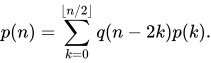
The same sequence of pentagonal numbers appears in a recurrence relation for the partition function:





Another recurrence relation for 

04Congruences
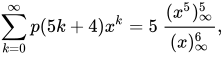
Srinivasa Ramanujan is credited with discovering that the partition function has nontrivial patterns in modular arithmetic.
For instance the number of partitions is divisible by five whenever the decimal representation of 

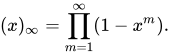
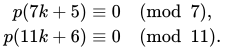
Ramanujan also discovered congruences modulo 7 and 11:

Since 5, 7, and 11 are consecutive primes, one might think that there would be an analogous congruence for the next prime 13, 




Ken Ono (2000) proved that there are such congruences for every prime modulus greater than 3. Later, Ahlgren & Ono (2001) showed there are partition congruences modulo every integer coprime to 6.
Newman's conjecture is an unsolved problem regarding the congruences of the partition function, formulated by mathematician Morris Newman in 1960. The conjecture posits that, given any integers r, m where 

05Approximation formulas
Approximation formulas exist that are faster to calculate than the exact formula given above.
An asymptotic expression for p(n) is given by
as
.
This asymptotic formula was first obtained by G. H. Hardy and Ramanujan in 1918 and independently by J. V. Uspensky in 1920. Considering 

Hardy and Ramanujan obtained an asymptotic expansion with this approximation as the first term:
![p(n)\sim {\frac {1}{2\pi {\sqrt {2}}}}\sum _{k=1}^{v}A_{k}(n){\sqrt {k}}\cdot {\frac {d}{dn}}\left({{\frac {1}{\sqrt {n-{\frac {1}{24}}}}}\exp \left[{{\frac {\pi }{k}}{\sqrt {{\frac {2}{3}}\left(n-{\frac {1}{24}}\right)}}}\,\,\,\right]}\right),](https://wikimedia.org/api/rest_v1/media/math/render/svg/04ceae2693bf7f43119090335f73b00f55c9c3bf)


The error after 


In 1937, Hans Rademacher was able to improve on Hardy and Ramanujan's results by providing a convergent series expression for
![p(n)={\frac {1}{\pi {\sqrt {2}}}}\sum _{k=1}^{\infty }A_{k}(n){\sqrt {k}}\cdot {\frac {d}{dn}}\left({{\frac {1}{\sqrt {n-{\frac {1}{24}}}}}\sinh \left[{{\frac {\pi }{k}}{\sqrt {{\frac {2}{3}}\left(n-{\frac {1}{24}}\right)}}}\,\,\,\right]}\right).](https://wikimedia.org/api/rest_v1/media/math/render/svg/91a531a51cf48ba80587a05f67f44d390aba14fc)
The proof of Rademacher's formula involves Ford circles, Farey sequences, modular symmetry and the Dedekind eta function.
It may be shown that the 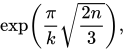
Techniques for implementing the Hardy-Ramanujan-Rademacher formula efficiently on a computer are discussed by Johansson (2012), who shows that 


06Strict partition function
Definition and properties
A partition in which no part occurs more than once is called strict, or is said to be a partition into distinct parts. The function q(n) gives the number of these strict partitions of the given sum n. For example, q(3) = 2 because the partitions 3 and 1 + 2 are strict, while the third partition 1 + 1 + 1 of 3 has repeated parts. The number q(n) is also equal to the number of partitions of n in which only odd summands are permitted.
| n | q(n) | Strict partitions | Partitions with only odd parts |
|---|---|---|---|
| 0 | 1 | () empty partition | () empty partition |
| 1 | 1 | 1 | 1 |
| 2 | 1 | 2 | 1+1 |
| 3 | 2 | 1+2, 3 | 1+1+1, 3 |
| 4 | 2 | 1+3, 4 | 1+1+1+1, 1+3 |
| 5 | 3 | 2+3, 1+4, 5 | 1+1+1+1+1, 1+1+3, 5 |
| 6 | 4 | 1+2+3, 2+4, 1+5, 6 | 1+1+1+1+1+1, 1+1+1+3, 3+3, 1+5 |
| 7 | 5 | 1+2+4, 3+4, 2+5, 1+6, 7 | 1+1+1+1+1+1+1, 1+1+1+1+3, 1+3+3, 1+1+5, 7 |
| 8 | 6 | 1+3+4, 1+2+5, 3+5, 2+6, 1+7, 8 | 1+1+1+1+1+1+1+1, 1+1+1+1+1+3, 1+1+3+3, 1+1+1+5, 3+5, 1+7 |
| 9 | 8 | 2+3+4, 1+3+5, 4+5, 1+2+6, 3+6, 2+7, 1+8, 9 | 1+1+1+1+1+1+1+1+1, 1+1+1+1+1+1+3, 1+1+1+3+3, 3+3+3, 1+1+1+1+5, 1+3+5, 1+1+7, 9 |
Generating function
The generating function for the numbers q(n) is given by a simple infinite product:


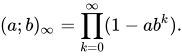

![\sum _{n=0}^{\infty }q(n)x^{n}=\vartheta _{00}(x)^{1/6}\vartheta _{01}(x)^{-1/3}{\biggl \{}{\frac {1}{16\,x}}{\bigl [}\vartheta _{00}(x)^{4}-\vartheta _{01}(x)^{4}{\bigr ]}{\biggr \}}^{1/24},](https://wikimedia.org/api/rest_v1/media/math/render/svg/7b6cfb3c0159d770c315b22b90316bfb8ae22033)

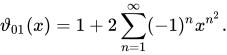
![\sum _{n=0}^{\infty }p(n)x^{n}=(x;x)_{\infty }^{-1}=\vartheta _{00}(x)^{-1/6}\vartheta _{01}(x)^{-2/3}{\biggl \{}{\frac {1}{16\,x}}{\bigl [}\vartheta _{00}(x)^{4}-\vartheta _{01}(x)^{4}{\bigr ]}{\biggr \}}^{-1/24}.](https://wikimedia.org/api/rest_v1/media/math/render/svg/d1197f6f79095ff46af1d8a9bb5617f18d2beec4)
Identities on strict partition numbers
The following identity involving a product of two Pochhammer symbols holds:

From this identity, using generating functions gives
![{\biggl [}\sum _{n=0}^{\infty }p(n)x^{n}{\biggr ]}={\biggl [}\sum _{n=0}^{\infty }p(n)x^{2n}{\biggr ]}{\biggl [}\sum _{n=0}^{\infty }q(n)x^{n}{\biggr ]}](https://wikimedia.org/api/rest_v1/media/math/render/svg/539815eff209a5f350ab0768f832f31724971e1e)
Upon comparing coefficients, one then obtains the following two relations:
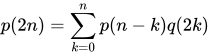
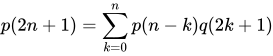
Here, two examples are accurately executed:
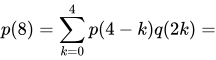


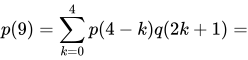


07Restricted partition function
More generally, it is possible to consider partitions restricted to only elements of a subset A of the natural numbers (for example a restriction on the maximum value of the parts), or with a restriction on the number of parts or the maximum difference between parts. Each particular restriction gives rise to an associated partition function with specific properties. Some common examples are given below.
Euler and Glaisher's theorem
Two important examples are the partitions restricted to only odd integer parts or only even integer parts, with the corresponding partition functions often denoted 

A theorem from Euler shows that the number of strict partitions is equal to the number of partitions with only odd parts: for all n, 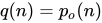
Restrictions on number of parts and part sizes
Let 
A recurrence for

and its generating function is
.
For fixed k, an asymptotic expression is given by
as
Gaussian binomial coefficient
More generally, if we denote 
.
Asymptotics
Some general results on the asymptotic properties of restricted partition functions are known. If pA(n) is the partition function of partitions restricted to only elements of a subset A of the natural numbers, then:
If A possesses positive natural density α then 

and conversely if this asymptotic property holds for pA(n) then A has natural density α. This result was stated, with a sketch of proof, by Erdős in 1942.
If A is a finite set, this analysis does not apply (the density of a finite set is zero). If A has k elements whose greatest common divisor is 1, then

Sources and credits
This article is adapted from the Wikipedia article “Partition function (number theory)”, written by its contributors and licensed under CC BY-SA 4.0. Fathomly has changed the layout, removed citation markers, navigation and maintenance notices, and adjusted punctuation. This adapted version is shared under the same license. For references, see the original article.
Images, from Wikimedia Commons:
- Ferrer partitioning diagrams.svg by R. A. Nonenmacher, CC BY-SA 4.0
- Euler partition function.svg by Cmglee, CC BY-SA 4.0
Fathomly is not affiliated with or endorsed by the Wikimedia Foundation. Spotted a problem? Tell us.