Reference articles on history, science, culture and more
Encyclopedia

Euler function

Mathematical function

Image credit is listed at the end of this article.

In mathematics, the Euler function is given by
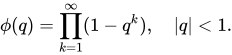
\phi (q)=\prod _{k=1}^{\infty }(1-q^{k}),\quad |q|<1.

Named after Leonhard Euler, it is a model example of a q-series and provides the prototypical example of a relation between combinatorics and complex analysis.

01Properties

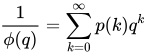
The coefficient p(k) in the formal power series expansion for 1/\phi (q) gives the number of partitions of k. That is,

{\frac {1}{\phi (q)}}=\sum _{k=0}^{\infty }p(k)q^{k}

where p is the partition function.

The Euler identity, also known as the Pentagonal number theorem, is
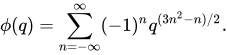
\phi (q)=\sum _{n=-\infty }^{\infty }(-1)^{n}q^{(3n^{2}-n)/2}.

(3n^{2}-n)/2 is a pentagonal number.

The Euler function is related to the Dedekind eta function as

\phi (e^{2\pi i\tau })=e^{-\pi i\tau /12}\eta (\tau ).

The Euler function may be expressed as a q-Pochhammer symbol:

\phi (q)=(q;q)_{\infty }.

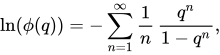
The logarithm of the Euler function is the sum of the logarithms in the product expression, each of which may be expanded about q=0, yielding

\ln(\phi (q))=-\sum _{n=1}^{\infty }{\frac {1}{n}}\,{\frac {q^{n}}{1-q^{n}}},

which is a Lambert series with coefficients -1/n. The logarithm of the Euler function may therefore be expressed as
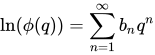
\ln(\phi (q))=\sum _{n=1}^{\infty }b_{n}q^{n}

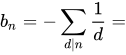
where b_{n}=-\sum _{d|n}{\frac {1}{d}}= -[1/1, 3/2, 4/3, 7/4, 6/5, 12/6, 8/7, 15/8, 13/9, 18/10, ...] (see OEIS A000203)

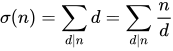
On account of the identity \sigma (n)=\sum _{d|n}d=\sum _{d|n}{\frac {n}{d}} , where \sigma (n) is the sum-of-divisors function, this may also be written as

\ln(\phi (q))=-\sum _{n=1}^{\infty }{\frac {\sigma (n)}{n}}\ q^{n}.

Also if a,b\in \mathbb {R} ^{+} and ab=\pi ^{2}, then

a^{1/4}e^{-a/12}\phi (e^{-2a})=b^{1/4}e^{-b/12}\phi (e^{-2b}).
Euler function .
Euler function .

02Special values

The next identities come from Ramanujan's Notebooks:
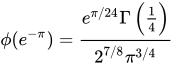
\phi (e^{-\pi })={\frac {e^{\pi /24}\Gamma \left({\frac {1}{4}}\right)}{2^{7/8}\pi ^{3/4}}}
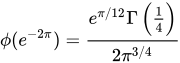
\phi (e^{-2\pi })={\frac {e^{\pi /12}\Gamma \left({\frac {1}{4}}\right)}{2\pi ^{3/4}}}
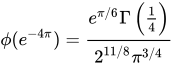
\phi (e^{-4\pi })={\frac {e^{\pi /6}\Gamma \left({\frac {1}{4}}\right)}{2^{{11}/8}\pi ^{3/4}}}
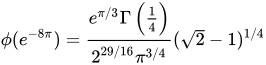
\phi (e^{-8\pi })={\frac {e^{\pi /3}\Gamma \left({\frac {1}{4}}\right)}{2^{29/16}\pi ^{3/4}}}({\sqrt {2}}-1)^{1/4}

Using the Pentagonal number theorem, exchanging sum and integral, and then invoking complex-analytic methods, one derives
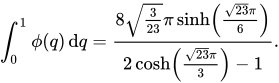
\int _{0}^{1}\phi (q)\,\mathrm {d} q={\frac {8{\sqrt {\frac {3}{23}}}\pi \sinh \left({\frac {{\sqrt {23}}\pi }{6}}\right)}{2\cosh \left({\frac {{\sqrt {23}}\pi }{3}}\right)-1}}.
Watch videos about Euler functionExplainers and documentaries on YouTube (opens in a new tab)

Sources and credits

This article is adapted from the Wikipedia article Euler function, written by its contributors and licensed under CC BY-SA 4.0. Fathomly has changed the layout, removed citation markers, navigation and maintenance notices, and adjusted punctuation. This adapted version is shared under the same license. For references, see the original article.

Images, from Wikimedia Commons:

Fathomly is not affiliated with or endorsed by the Wikimedia Foundation. Spotted a problem? Tell us.