Parity function
Function in Boolean algebra
In Boolean algebra, a parity function is a Boolean function whose value is one if and only if the input vector has an odd number of ones. The parity function of two inputs is also known as the XOR function.
The parity function is notable for its role in theoretical investigation of circuit complexity of Boolean functions.
The output of the parity function is the parity bit.
01Definition
The 




where 
02Properties
Parity only depends on the number of ones and is therefore a symmetric Boolean function.
The n-variable parity function and its negation are the only Boolean functions for which all disjunctive normal forms have the maximal number of 2 n − 1 monomials of length n and all conjunctive normal forms have the maximal number of 2 n − 1 clauses of length n.
03Computational complexity
Some of the earliest work in computational complexity was 1961 bound of Bella Subbotovskaya showing the size of a Boolean formula computing parity must be at least 


In the early 1980s, Merrick Furst, James Saxe and Michael Sipser and independently Miklós Ajtai established super-polynomial lower bounds on the size of constant-depth Boolean circuits for the parity function, i.e., they showed that polynomial-size constant-depth circuits cannot compute the parity function. Similar results were also established for the majority, multiplication and transitive closure functions, by reduction from the parity function.
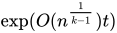
Håstad (1987) established tight exponential lower bounds on the size of constant-depth Boolean circuits for the parity function. Håstad's Switching Lemma is the key technical tool used for these lower bounds and Johan Håstad was awarded the Gödel Prize for this work in 1994.
The precise result is that depth-k circuits with AND, OR, and NOT gates require size 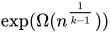
04Infinite version
An infinite parity function is a function 


Assuming axiom of choice it can be proved that parity functions exist and there are 


Another construction of an infinite parity function can be done using a non-principal ultrafilter 


It is necessary to assume at least some amount of choice to prove that infinite parity functions exist. If ![f^{-1}[0]](https://wikimedia.org/api/rest_v1/media/math/render/svg/9e6e10867d4537921fb1e5199e8dac6c575da042)
Sources and credits
This article is adapted from the Wikipedia article “Parity function”, written by its contributors and licensed under CC BY-SA 4.0. Fathomly has changed the layout, removed citation markers, navigation and maintenance notices, and adjusted punctuation. This adapted version is shared under the same license. For references, see the original article.
Fathomly is not affiliated with or endorsed by the Wikimedia Foundation. Spotted a problem? Tell us.