Walsh function
Concept in mathematics
In mathematics, more specifically in harmonic analysis, Walsh functions form a complete orthogonal set of functions that can be used to represent any discrete function, just like trigonometric functions can be used to represent any continuous function in Fourier analysis. They can thus be viewed as a discrete, digital counterpart of the continuous, analog system of trigonometric functions on the unit interval. But unlike the sine and cosine functions, which are continuous, Walsh functions are piecewise constant. They take the values −1 and +1 only, on sub-intervals defined by dyadic fractions.
The system of Walsh functions is known as the Walsh system. It is an extension of the Rademacher system of orthogonal functions.
Walsh functions, the Walsh system, the Walsh series, and the fast Walsh-Hadamard transform are all named after the American mathematician Joseph L. Walsh. They find various applications in physics and engineering when analyzing digital signals.
Historically, various numerations of Walsh functions have been used; none of them is particularly superior to another. This articles uses the Walsh-Paley numeration.
01Definition
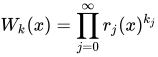
We define the sequence of Walsh functions ![W_{k}:[0,1]\rightarrow \{-1,1\}](https://wikimedia.org/api/rest_v1/media/math/render/svg/fcf0ea378192a0285499e91e56802ee3e39263e6)

For any natural number k, and real number ![x\in [0,1]](https://wikimedia.org/api/rest_v1/media/math/render/svg/64a15936df283add394ab909aa7a5e24e7fb6bb2)
be the jth bit in the binary representation of k, starting with
as the least significant bit, and
be the jth bit in the fractional binary representation of
, starting with
as the most significant fractional bit.
Then, by definition

In particular, 
Notice that 

02Comparison between Walsh functions and trigonometric functions
Walsh functions and trigonometric functions are both systems that form a complete, orthonormal set of functions, an orthonormal basis in the Hilbert space ![L^{2}[0,1]](https://wikimedia.org/api/rest_v1/media/math/render/svg/0cec70e845808e22e359ab32ed7c3c0d946fab70)
Both trigonometric and Walsh systems admit natural extension by periodicity from the unit interval to the real line. Furthermore, both Fourier analysis on the unit interval (Fourier series) and on the real line (Fourier transform) have their digital counterparts defined via Walsh system, the Walsh series analogous to the Fourier series, and the Hadamard transform analogous to the Fourier transform.
03Properties
The Walsh system 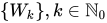


The Walsh system is an orthonormal basis of the Hilbert space
,
and being a basis means that if, for every ![f\in L^{2}[0,1]](https://wikimedia.org/api/rest_v1/media/math/render/svg/281917dc3cad98c959a68675b13527d8966ae198)
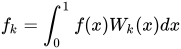
![\int _{0}^{1}(f(x)-\sum _{k=0}^{N}f_{k}W_{k}(x))^{2}dx\;\ {\xrightarrow[{N\rightarrow \infty }]{}}\;\ 0](https://wikimedia.org/api/rest_v1/media/math/render/svg/a309ccd41aaad7f2cd9bdf1130d0868940c32b49)
It turns out that for every 

The Walsh system (in Walsh-Paley numeration) forms a Schauder basis in ![L^{p}[0,1]](https://wikimedia.org/api/rest_v1/media/math/render/svg/074d3256c04192f1a67715d3b1132b1a295ff5a6)

![L^{1}[0,1]](https://wikimedia.org/api/rest_v1/media/math/render/svg/b8d50b231f054c5144afd0bd5f0f3211310a9ba3)
04Generalizations
Walsh-Ferleger systems
Let 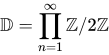
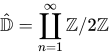


Then basic representation theory suggests the following broad generalization of the concept of Walsh system.
For an arbitrary Banach space 







where 
In the early 1990s, Serge Ferleger and Fyodor Sukochev showed that in a broad class of Banach spaces (so called UMD spaces) generalized Walsh systems have many properties similar to the classical one: they form a Schauder basis and a uniform finite-dimensional decomposition in the space, have property of random unconditional convergence. One important example of generalized Walsh system is Fermion Walsh system in non-commutative Lp spaces associated with hyperfinite type II factor.
Fermion Walsh system
The Fermion Walsh system is a non-commutative, or "quantum" analog of the classical Walsh system. Unlike the latter, it consists of operators, not functions. Nevertheless, both systems share many important properties, e.g., both form an orthonormal basis in corresponding Hilbert space, or Schauder basis in corresponding symmetric spaces. Elements of the Fermion Walsh system are called Walsh operators.
The term Fermion in the name of the system is explained by the fact that the enveloping operator space, the so-called hyperfinite type II factor 


Vilenkin system
Fix a sequence 

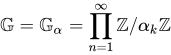



![\left|x\right|=\sum _{k=1}^{\infty }{\frac {x_{k}}{A_{k}}}\in \left[0,1\right].](https://wikimedia.org/api/rest_v1/media/math/render/svg/30065240bf8d3be4c467e61738b656d1ea7663ec)
This correspondence is a module zero isomorphism between 



The set 
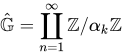



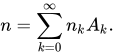
Then 
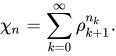
In particular, if 

The Vilenkin system is a complete orthonormal system on 
Nonlinear Phase Extensions
Nonlinear phase extensions of discrete Walsh-Hadamard transform were developed. It was shown that the nonlinear phase basis functions with improved cross-correlation properties significantly outperform the traditional Walsh codes in code division multiple access (CDMA) communications.
05Applications
Applications of the Walsh functions can be found wherever digit representations are used, including speech recognition, medical and biological image processing, and digital holography.
For example, the fast Walsh-Hadamard transform (FWHT) may be used in the analysis of digital quasi-Monte Carlo methods. In radio astronomy, Walsh functions can help reduce the effects of electrical crosstalk between antenna signals. They are also used in passive LCD panels as X and Y binary driving waveforms where the autocorrelation between X and Y can be made minimal for pixels that are off.
Sources and credits
This article is adapted from the Wikipedia article “Walsh function”, written by its contributors and licensed under CC BY-SA 4.0. Fathomly has changed the layout, removed citation markers, navigation and maintenance notices, and adjusted punctuation. This adapted version is shared under the same license. For references, see the original article.
Images, from Wikimedia Commons:
- Natural and sequency ordered Walsh 16.svg by Watchduck You can name the author as "T. Piesk", "Tilman Piesk" or "Watchduck"., Public domain
Fathomly is not affiliated with or endorsed by the Wikimedia Foundation. Spotted a problem? Tell us.

