Natural transformation
Central object of study in category theory
In category theory, a branch of mathematics, a natural transformation provides a way of transforming one functor into another while respecting the internal structure (i.e., the composition of morphisms) of the categories involved. Hence, a natural transformation can be considered to be a "morphism of functors". Informally, the notion of a natural transformation states that a particular map between functors can be done consistently over an entire category.
Indeed, this intuition can be formalized to define so-called functor categories. Natural transformations are, after categories and functors, one of the most fundamental notions of category theory and consequently appear in the majority of its applications.
01Definition
If 






This equation can be conveniently expressed by the following commutative diagram:
If both 

If, for every object
An infranatural transformation 


02Examples
Opposite group
Statements such as
- "Every group is naturally isomorphic to its opposite group"
abound in modern mathematics. We will now give the precise meaning of this statement as well as its proof. Consider the category






The content of the above statement is:
- "The identity functor
is naturally isomorphic to the opposite functor
"
To prove this, we need to provide isomorphisms 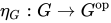








Abelianization
Given a group ![G^{\text{ab}}=G/[G,G]](https://wikimedia.org/api/rest_v1/media/math/render/svg/d74f89f61ba840ae2f99caf5bc4d3f5412e1aa1f)
![[G,G]](https://wikimedia.org/api/rest_v1/media/math/render/svg/6ddf7a724a331d1e12ffa6571ba246ebf08f1335)
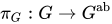







Hurewicz homomorphism
Functors and natural transformations abound in algebraic topology, with the Hurewicz homomorphisms serving as examples. For any pointed topological space 


from the 


Determinant
Given commutative rings 


which is natural in 
Double dual of a vector space
If 


Finite calculus
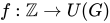
For every abelian group 












Tensor and Hom of modules
Let 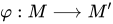






Tensor-hom adjunction
Consider the category 

.
These isomorphisms are "natural" in the sense that they define a natural transformation between the two involved functors 
This is formally the tensor-hom adjunction, and is an archetypal example of a pair of adjoint functors. Natural transformations arise frequently in conjunction with adjoint functors, and indeed, adjoint functors are defined by a certain natural isomorphism. Additionally, every pair of adjoint functors comes equipped with two natural transformations (generally not isomorphisms) called the unit and counit.

03Unnatural isomorphism
The notion of a natural transformation is categorical, and states (informally) that a particular map between functors can be done consistently over an entire category. Informally, a particular map (esp. an isomorphism) between individual objects (not entire categories) is referred to as a "natural isomorphism", meaning implicitly that it is actually defined on the entire category, and defines a natural transformation of functors; formalizing this intuition was a motivating factor in the development of category theory.
Conversely, a particular map between particular objects may be called an unnatural isomorphism (or "an isomorphism that is not natural") if the map cannot be extended to a natural transformation on the entire category. Given an object 
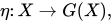




This is similar (but more categorical) to concepts in group theory or module theory, where a given decomposition of an object into a direct sum is "not natural", or rather "not unique", as automorphisms exist that do not preserve the direct sum decomposition, see Structure theorem for finitely generated modules over a principal ideal domain § Uniqueness for example.
Some authors distinguish notationally, using 


Example: dual of a finite-dimensional vector space
Every finite-dimensional vector space is isomorphic to its dual space, but there may be many different isomorphisms between the two spaces. There is in general no natural isomorphism between a finite-dimensional vector space and its dual space. However, related categories (with additional structure and restrictions on the maps) do have a natural isomorphism, as described below.
The dual space of a finite-dimensional vector space is again a finite-dimensional vector space of the same dimension, and these are thus isomorphic, since dimension is the only invariant of finite-dimensional vector spaces over a given field. However, in the absence of additional constraints (such as a requirement that maps preserve the chosen basis), the map from a space to its dual is not unique, and thus such an isomorphism requires a choice, and is "not natural". On the category of finite-dimensional vector spaces and linear maps, one can define an infranatural isomorphism from vector spaces to their dual by choosing an isomorphism for each space (say, by choosing a basis for every vector space and taking the corresponding isomorphism), but this will not define a natural transformation. Intuitively this is because it required a choice, rigorously because any such choice of isomorphisms will not commute with, say, the zero map; see Mac Lane & Birkhoff (1999), §VI.4 for detailed discussion.
Starting from finite-dimensional vector spaces (as objects) and the identity and dual functors, one can define a natural isomorphism, but this requires first adding additional structure, then restricting the maps from "all linear maps" to "linear maps that respect this structure". Explicitly, for each vector space, require that it comes with the data of an isomorphism to its dual, 




In this category (finite-dimensional vector spaces with a nondegenerate bilinear form, maps linear transforms that respect the bilinear form), the dual of a map between vector spaces can be identified as a transpose. Often for reasons of geometric interest this is specialized to a subcategory, by requiring that the nondegenerate bilinear forms have additional properties, such as being symmetric (orthogonal matrices), symmetric and positive definite (inner product space), symmetric sesquilinear (Hermitian spaces), skew-symmetric and totally isotropic (symplectic vector space), etc., in all these categories a vector space is naturally identified with its dual, by the nondegenerate bilinear form.
04Operations with natural transformations
Vertical composition
If 


.
This vertical composition of natural transformations is associative and has an identity, and allows one to consider the collection of all functors 


- For
.
Horizontal composition
If 



.
By using whiskering (see below), we can write
,
hence
.
This horizontal composition of natural transformations is also associative with identity.
This identity is the identity natural transformation on the identity functor, i.e., the natural transformation that associates to each object its identity morphism: for object 

- For
.
As identity functors 

Whiskering
Whiskering is an external binary operation between a functor and a natural transformation.
If 

.
If on the other hand 

.
It's also a horizontal composition where one of the natural transformations is the identity natural transformation:
and
.
Note that 


Interchange law
The two operations are related by an identity which exchanges vertical composition with horizontal composition: if we have four natural transformations 
.
Vertical and horizontal compositions are also linked through identity natural transformations:
- for
and
,
.
As whiskering is horizontal composition with an identity, the interchange law gives immediately the compact formulas of horizontal composition of
.

05Functor categories
If 


The isomorphisms in 


The functor category 



More generally, one can build the 2-category 
- 0-cells (objects) are the small categories,
- 1-cells (arrows) between two objects
- 2-cells between two 1-cells (functors)
are the natural transformations from
The horizontal and vertical compositions are the compositions between natural transformations described previously. A functor category
More examples
Every limit and colimit provides an example for a simple natural transformation, as a cone amounts to a natural transformation with the diagonal functor as domain. Indeed, if limits and colimits are defined directly in terms of their universal property, they are universal morphisms in a functor category.
06Yoneda lemma
If 



07Historical notes
Saunders Mac Lane, one of the founders of category theory, is said to have remarked, "I didn't invent categories to study functors; I invented them to study natural transformations." Just as the study of groups is not complete without a study of homomorphisms, so the study of categories is not complete without the study of functors. The reason for Mac Lane's comment is that the study of functors is itself not complete without the study of natural transformations.
The context of Mac Lane's remark was the axiomatic theory of homology. Different ways of constructing homology could be shown to coincide: for example in the case of a simplicial complex the groups defined directly (simplicial homology) would be isomorphic to those of the singular theory. What cannot easily be expressed without the language of natural transformations is how homology groups are compatible with morphisms between objects, and how two equivalent homology theories not only have the same homology groups, but also the same morphisms between those groups.
Sources and credits
This article is adapted from the Wikipedia article “Natural transformation”, written by its contributors and licensed under CC BY-SA 4.0. Fathomly has changed the layout, removed citation markers, navigation and maintenance notices, and adjusted punctuation. This adapted version is shared under the same license. For references, see the original article.
Images, from Wikimedia Commons:
- Natural Transformation between two functors.svg by Lltrujello, CC BY-SA 4.0
- Natural transformation composition.svg by Petr Kadlec, using work by Theon, CC0
- Vertical composition of natural transformations.svg by Gerryfudd, CC BY-SA 4.0
- Horizontal composition of natural transformations.svg by Gerryfudd, CC BY-SA 4.0
Fathomly is not affiliated with or endorsed by the Wikimedia Foundation. Spotted a problem? Tell us.
