Maximal and minimal elements
Extreme element of a preorder

In mathematics, especially in order theory, a maximal element of a subset 
The notions of maximal and minimal elements are weaker than those of greatest element and least element which are also known, respectively, as maximum and minimum. The maximum of a subset 
As an example, in the collection

Zorn's lemma states that every partially ordered set for which every totally ordered subset has an upper bound contains at least one maximal element. This lemma is equivalent to the well-ordering theorem and the axiom of choice and implies major results in other mathematical areas like the Hahn-Banach theorem, the Kirszbraun theorem, Tychonoff's theorem, the existence of a Hamel basis for every vector space, and the existence of an algebraic closure for every field.
01Definition
Let 


- if
satisfies
then necessarily

Similarly, a minimal element of
- if
then necessarily
Equivalently, 


If the subset 


If the preordered set 


02Existence and uniqueness
Maximal elements need not exist.
- Example 1: Let
where
denotes the real numbers. For all
but
(that is,
).
- Example 2: Let
where
denotes the rational numbers and where
is irrational.

In general 


- Example 3: In the fence
all the
are minimal and all
are maximal, as shown in the image.
- Example 4: Let A be a set with at least two elements and let
be the subset of the power set
consisting of singleton subsets, partially ordered by
This is the discrete poset where no two elements are comparable and thus every element
is maximal (and minimal); moreover, for any distinct
neither
nor

03Greatest and least elements
For a partially ordered set 


;
;
and
are incomparable.
Given a subset 

- if case 1 never applies for any
then
- if case 1 and 4 never applies for any
Thus the definition of a greatest element is stronger than that of a maximal element.
Equivalently, a greatest element of a subset
The greatest element of 
When the restriction of 

Dual to greatest is the notion of least element that relates to minimal in the same way as greatest to maximal.
04Directed sets
In a totally ordered set, the terms maximal element and greatest element coincide, which is why both terms are used interchangeably in fields like analysis where only total orders are considered. This observation applies not only to totally ordered subsets of any partially ordered set, but also to their order theoretic generalization via directed sets. In a directed set, every pair of elements (particularly pairs of incomparable elements) has a common upper bound within the set. If a directed set has a maximal element, it is also its greatest element, and hence its only maximal element. For a directed set without maximal or greatest elements, see examples 1 and 2 above.
Similar conclusions are true for minimal elements.
Further introductory information is found in the article on order theory.
05Properties
- Each finite nonempty subset
with the usual order.
- The set of maximal elements of a subset
06Examples
- In Pareto efficiency, a Pareto optimum is a maximal element with respect to the partial order of Pareto improvement, and the set of maximal elements is called the Pareto frontier.
- In decision theory, an admissible decision rule is a maximal element with respect to the partial order of dominating decision rule.
- In modern portfolio theory, the set of maximal elements with respect to the product order on risk and return is called the efficient frontier.
- In set theory, a set is finite if and only if every non-empty family of subsets has a minimal element when ordered by the inclusion relation.
- In abstract algebra, the concept of a maximal common divisor is needed to generalize greatest common divisors to number systems in which the common divisors of a set of elements may have more than one maximal element.
- In computational geometry, the maxima of a point set are maximal with respect to the partial order of coordinatewise domination.
Consumer theory
In economics, one may relax the axiom of antisymmetry, using preorders (generally total preorders) instead of partial orders; the notion analogous to maximal element is very similar, but different terminology is used, as detailed below.
In consumer theory the consumption space is some set 


It should be remarked that the formal definition looks very much like that of a greatest element for an ordered set. However, when 

An obvious application is to the definition of demand correspondence. Let 



The demand correspondence maps any price 


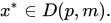
It is called demand correspondence because the theory predicts that for 
07Related notions
A subset 


A subset 


Sources and credits
This article is adapted from the Wikipedia article “Maximal and minimal elements”, written by its contributors and licensed under CC BY-SA 4.0. Fathomly has changed the layout, removed citation markers, navigation and maintenance notices, and adjusted punctuation. This adapted version is shared under the same license. For references, see the original article.
Images, from Wikimedia Commons:
- Lattice of the divisibility of 60 narrow 1,2,3,4.svg by JohnBlackburne, CC BY-SA 3.0
- Zigzag poset.svg by David Eppstein, Public domain
Fathomly is not affiliated with or endorsed by the Wikimedia Foundation. Spotted a problem? Tell us.
