Local boundedness
In mathematics, a function is locally bounded if it is bounded around every point. A family of functions is locally bounded if for any point in their domain all the functions are bounded around that point and by the same number.
01Locally bounded function
A real-valued or complex-valued function 



In other words, for each 


This definition can be extended to the case when 


02Examples
- The function
defined by
is bounded, because
for all
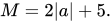
- The function
is not bounded, as it becomes arbitrarily large. However, it is locally bounded because for each
in the neighborhood
where

- The function
is neither bounded nor locally bounded. In any neighborhood of 0 this function takes values of arbitrarily large magnitude.
- Any continuous function is locally bounded. Here is a proof for functions of a real variable. Let
be continuous where
and we will show that
for all
Taking ε = 1 in the definition of continuity, there exists
such that
for all
with
. Now by the triangle inequality,
which means that
and the neighborhood
). This argument generalizes easily to when the domain of
- The converse of the above result is not true however; that is, a discontinuous function may be locally bounded. For example consider the function
and
for all
Then
and the neighborhood
for example.
03Locally bounded family
A set (also called a family) U of real-valued or complex-valued functions defined on some topological space 

This definition can also be extended to the case when the functions in the family U take values in some metric space, by again replacing the absolute value with the distance function.
04Examples
- The family of functions
where
is locally bounded. Indeed, if
Then for all
one has
with
Moreover, the family is uniformly bounded, because neither the neighborhood
depend on the index


- The family of functions
is locally bounded, if
is greater than zero. For any
itself. Then we have
Note that the value of
This family is then not only locally bounded, it is also uniformly bounded.
- The family of functions
is not locally bounded. Indeed, for any
cannot be bounded as
05Topological vector spaces
Local boundedness may also refer to a property of topological vector spaces, or of functions from a topological space into a topological vector space (TVS).
Locally bounded topological vector spaces
A subset 



Locally bounded functions
Let
The following theorem relates local boundedness of functions with the local boundedness of topological vector spaces:
- Theorem. A topological vector space
is locally bounded.
Sources and credits
This article is adapted from the Wikipedia article “Local boundedness”, written by its contributors and licensed under CC BY-SA 4.0. Fathomly has changed the layout, removed citation markers, navigation and maintenance notices, and adjusted punctuation. This adapted version is shared under the same license. For references, see the original article.
Fathomly is not affiliated with or endorsed by the Wikimedia Foundation. Spotted a problem? Tell us.