Knuth-Bendix completion algorithm
Semi-decision algorithm for transforming a set of equations
The Knuth-Bendix completion algorithm (named after Donald Knuth and Peter Bendix) is a semi-decision algorithm for transforming a set of equations (over terms) into a confluent term rewriting system. When the algorithm succeeds, it effectively solves the word problem for the specified algebra.
Buchberger's algorithm for computing Gröbner bases is a very similar algorithm. Although developed independently, it may also be seen as the instantiation of Knuth-Bendix algorithm in the theory of polynomial rings.
01Introduction
For a set E of equations, its deductive closure (⁎⟷E) is the set of all equations that can be derived by applying equations from E in any order. Formally, E is considered a binary relation, (⟶E) is its rewrite closure, and (⁎⟷E) is the equivalence closure of (⟶E). For a set R of rewrite rules, its deductive closure (⁎⟶R ∘ ⁎⟵R) is the set of all equations that can be confirmed by applying rules from R left-to-right to both sides until they are literally equal. Formally, R is again viewed as a binary relation, (⟶R) is its rewrite closure, (⟵R) is its converse, and (⁎⟶R ∘ ⁎⟵R) is the relation composition of their reflexive transitive closures (⁎⟶R and ⁎⟵R).
For example, if E = {1⋅x = x, x−1⋅x = 1, (x⋅y)⋅z = x⋅(y⋅z)} are the group axioms, the derivation chain
- a−1⋅(a⋅b) ⁎⟷E (a−1⋅a)⋅b ⁎⟷E 1⋅b ⁎⟷E b
demonstrates that a−1⋅(a⋅b) ⁎⟷E b is a member of E's deductive closure. If R = { 1⋅x → x, x−1⋅x → 1, (x⋅y)⋅z → x⋅(y⋅z) } is a "rewrite rule" version of E, the derivation chains
- (a−1⋅a)⋅b ⁎⟶R 1⋅b ⁎⟶R b and b ⁎⟵R b
demonstrate that (a−1⋅a)⋅b ⁎⟶R∘⁎⟵R b is a member of R's deductive closure. However, there is no way to derive a−1⋅(a⋅b) ⁎⟶R∘⁎⟵R b similar to above, since a right-to-left application of the rule (x⋅y)⋅z → x⋅(y⋅z) is not allowed.
The Knuth-Bendix algorithm takes a set E of equations between terms, and a reduction ordering (>) on the set of all terms, and attempts to construct a confluent and terminating term rewriting system R that has the same deductive closure as E. While proving consequences from E often requires human intuition, proving consequences from R does not. For more details, see Confluence (abstract rewriting)#Motivating examples, which gives an example proof from group theory, performed both using E and using R.
02Rules
Given a set E of equations between terms, the following inference rules can be used to transform it into an equivalent convergent term rewrite system (if possible): They are based on a user-given reduction ordering (>) on the set of all terms; it is lifted to a well-founded ordering (▻) on the set of rewrite rules by defining (s → t) ▻ (l → r) if
- s >e l in the encompassment ordering, or
- s and l are literally similar and t > r.
| Delete | ‹ E∪{s = s} | , R › | ⊢ | ‹ E | , R › | |
| Compose | ‹ E | , R∪{s → t} › | ⊢ | ‹ E | , R∪{s → u} › | if t ⟶R u |
| Simplify | ‹ E∪{s = t} | , R › | ⊢ | ‹ E∪{s = u} | , R › | if t ⟶R u |
| Orient | ‹ E∪{s = t} | , R › | ⊢ | ‹ E | , R∪{s → t} › | if s > t |
| Collapse | ‹ E | , R∪{s → t} › | ⊢ | ‹ E∪{u = t} | , R › | if s ⟶R u by l → r with (s → t) ▻ (l → r) |
| Deduce | ‹ E | , R › | ⊢ | ‹ E∪{s = t} | , R › | if (s,t) is a critical pair of R |
03Example
The following example run, obtained from the E theorem prover, computes a completion of the (additive) group axioms as in Knuth, Bendix (1970). It starts with the three initial equations for the group (neutral element 0, inverse elements, associativity), using f(X,Y) for X+Y, and i(X) for −X. The 10 starred equations turn out to constitute the resulting convergent rewrite system. "pm" is short for "paramodulation", implementing deduce. Critical pair computation is an instance of paramodulation for equational unit clauses. "rw" is rewriting, implementing compose, collapse, and simplify. Orienting of equations is done implicitly and not recorded.
| Nr | Lhs | Rhs | Source | ||
| 1: | * | f(X,0) | = | X | initial("GROUP.lop", at_line_9_column_1) |
| 2: | * | f(X,i(X)) | = | 0 | initial("GROUP.lop", at_line_12_column_1) |
| 3: | * | f(f(X,Y),Z) | = | f(X,f(Y,Z)) | initial("GROUP.lop", at_line_15_column_1) |
| 5: | f(X,Y) | = | f(X,f(0,Y)) | pm(3,1) | |
| 6: | f(X,f(Y,i(f(X,Y)))) | = | 0 | pm(2,3) | |
| 7: | f(0,Y) | = | f(X,f(i(X),Y)) | pm(3,2) | |
| 27: | f(X,0) | = | f(0,i(i(X))) | pm(7,2) | |
| 36: | X | = | f(0,i(i(X))) | rw(27,1) | |
| 46: | f(X,Y) | = | f(X,i(i(Y))) | pm(5,36) | |
| 52: | * | f(0,X) | = | X | rw(36,46) |
| 60: | * | i(0) | = | 0 | pm(2,52) |
| 63: | i(i(X)) | = | f(0,X) | pm(46,52) | |
| 64: | * | f(X,f(i(X),Y)) | = | Y | rw(7,52) |
| 67: | * | i(i(X)) | = | X | rw(63,52) |
| 74: | * | f(i(X),X) | = | 0 | pm(2,67) |
| 79: | f(0,Y) | = | f(i(X),f(X,Y)) | pm(3,74) | |
| 83: | * | Y | = | f(i(X),f(X,Y)) | rw(79,52) |
| 134: | f(i(X),0) | = | f(Y,i(f(X,Y))) | pm(83,6) | |
| 151: | i(X) | = | f(Y,i(f(X,Y))) | rw(134,1) | |
| 165: | * | f(i(X),i(Y)) | = | i(f(Y,X)) | pm(83,151) |
See also Word problem (mathematics) for another presentation of this example.
04String rewriting systems in group theory
An important case in computational group theory is string rewriting systems which can be used to give canonical labels to elements or cosets of a finitely presented group as products of the generators. This special case is the focus of this section.
Motivation in group theory
The critical pair lemma states that a term rewriting system is locally confluent (or weakly confluent) if and only if all its critical pairs are convergent. Furthermore, we have Newman's lemma which states that if an (abstract) rewriting system is strongly normalizing and weakly confluent, then the rewriting system is confluent. So, if we can add rules to the term rewriting system in order to force all critical pairs to be convergent while maintaining the strong normalizing property, then this will force the resultant rewriting system to be confluent.
Consider a finitely presented monoid 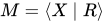
Although the choice of a canonical form can theoretically be made in an arbitrary fashion this approach is generally not computable. (Consider that an equivalence relation on a language can produce an infinite number of infinite classes.) If the language is well-ordered then the order < gives a consistent method for defining minimal representatives, however computing these representatives may still not be possible. In particular, if a rewriting system is used to calculate minimal representatives then the order < should also have the property:
- A < B → XAY < XBY for all words A,B,X,Y
This property is called translation invariance. An order that is both translation-invariant and a well-order is called a reduction order.
From the presentation of the monoid it is possible to define a rewriting system given by the relations R. If A x B is in R then either A < B in which case B → A is a rule in the rewriting system, otherwise A > B and A → B. Since < is a reduction order a given word W can be reduced W > W_1 > ... > W_n where W_n is irreducible under the rewriting system. However, depending on the rules that are applied at each Wi → Wi+1 it is possible to end up with two different irreducible reductions Wn ≠ W'm of W. However, if the rewriting system given by the relations is converted to a confluent rewriting system via the Knuth-Bendix algorithm, then all reductions are guaranteed to produce the same irreducible word, namely the normal form for that word.
Description of the algorithm for finitely presented monoids
Suppose we are given a presentation 


First, if any relation 

Next, we add more reductions (that is, rewriting rules) to eliminate possible exceptions of confluence. Suppose that 
- Case 1: either the prefix of
and
; in the latter case,
and
.
- Case 2: either
and
; in the latter case,
and
.
Reduce the word 



After adding a rule to
Repeat the procedure until all overlapping left sides have been checked.
Examples
A terminating example
Consider the monoid:
.
We use the shortlex order. This is an infinite monoid but nevertheless, the Knuth-Bendix algorithm is able to solve the word problem.
Our beginning three reductions are therefore
 | 1 |
 | 2 |
 . . | 3 |
A suffix of 




 . . | 4 |
Similarly, using 

 . . | 5 |
Both of these rules obsolete (3), so we remove it.
Next, consider 
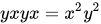
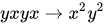 . . | 6 |
Considering 
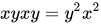
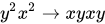 . . | 7 |
These obsolete rules (4) and (5), so we remove them.
Now, we are left with the rewriting system
| (1) |
| (2) |
| (6) |
| . | (7) |
Checking the overlaps of these rules, we find no potential failures of confluence. Therefore, we have a confluent rewriting system, and the algorithm terminates successfully.
A non-terminating example
The order of the generators may crucially affect whether the Knuth-Bendix completion terminates. As an example, consider the free Abelian group by the monoid presentation:

The Knuth-Bendix completion with respect to lexicographic order 

05Generalizations
If Knuth-Bendix does not succeed, it will either run forever and produce successive approximations to an infinite complete system, or fail when it encounters an unorientable equation (i.e. an equation that it cannot turn into a rewrite rule). An enhanced version will not fail on unorientable equations and produces a ground confluent system, providing a semi-algorithm for the word problem.
The notion of logged rewriting discussed in the paper by Heyworth and Wensley listed below allows some recording or logging of the rewriting process as it proceeds. This is useful for computing identities among relations for presentations of groups.
Sources and credits
This article is adapted from the Wikipedia article “Knuth-Bendix completion algorithm”, written by its contributors and licensed under CC BY-SA 4.0. Fathomly has changed the layout, removed citation markers, navigation and maintenance notices, and adjusted punctuation. This adapted version is shared under the same license. For references, see the original article.
Fathomly is not affiliated with or endorsed by the Wikimedia Foundation. Spotted a problem? Tell us.