Kernel (set theory)
Equivalence relation expressing that two elements have the same image under a function
In set theory, the kernel of a function (or equivalence kernel) may be taken to be either
- the equivalence relation on the function's domain that roughly expresses the idea of "equivalent as far as the function
can tell", or
- the corresponding partition of the domain.
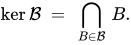
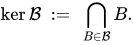
An unrelated notion is that of the kernel of a non-empty family of sets which by definition is the intersection of all its elements:
This definition is used in the theory of filters to classify them as being free or principal.
01Definition
Kernel of a function
For the formal definition, let be a function between two sets.
Elements
are equivalent if and only if
and
are equal, that is, are the same element of
The kernel of
is the equivalence relation thus defined.
Kernel of a family of sets
The kernel of a family of sets is
The kernel of
is also sometimes denoted by
The kernel of the empty set,
is typically left undefined.
A family is called fixed and is said to have non-empty intersection if its kernel is not empty.
A family is said to be free if it is not fixed; that is, if its kernel is the empty set.
02Quotients
Like any equivalence relation, the kernel can be modded out to form a quotient set, and the quotient set is the partition:

This quotient set is called the coimage of the function
and denoted
(or a variation).
The coimage is naturally isomorphic (in the set-theoretic sense of a bijection) to the image,
specifically, the equivalence class of
in
(which is an element of
) corresponds to
in
(which is an element of
).
03As a subset of the Cartesian product
Like any binary relation, the kernel of a function may be thought of as a subset of the Cartesian product
In this guise, the kernel may be denoted
(or a variation) and may be defined symbolically as
The study of the properties of this subset can shed light on
04Algebraic structures
If and
are algebraic structures of some fixed type (such as groups, rings, or vector spaces), and if the function
is a homomorphism, then
is a congruence relation (that is an equivalence relation that is compatible with the algebraic structure), and the coimage of
is a quotient of
The bijection between the coimage and the image of
is an isomorphism in the algebraic sense; this is the most general form of the first isomorphism theorem.
05In topology
If is a continuous function between two topological spaces then the topological properties of
can shed light on the spaces
and
For example, if
is a Hausdorff space then
must be a closed set.
Conversely, if
is a Hausdorff space and
is a closed set, then the coimage of
if given the quotient space topology, must also be a Hausdorff space.
A space is compact if and only if the kernel of every family of closed subsets having the finite intersection property (FIP) is non-empty; said differently, a space is compact if and only if every family of closed subsets with F.I.P. is fixed.
Sources and credits
This article is adapted from the Wikipedia article “Kernel (set theory)”, written by its contributors and licensed under CC BY-SA 4.0. Fathomly has changed the layout, removed citation markers, navigation and maintenance notices, and adjusted punctuation. This adapted version is shared under the same license. For references, see the original article.
Fathomly is not affiliated with or endorsed by the Wikimedia Foundation. Spotted a problem? Tell us.