Huber loss
Loss function used in robust regression
In statistics, the Huber loss is a loss function used in robust regression, that is less sensitive to outliers in data than the squared error loss. A variant for classification is also sometimes used.
01Definition
The Huber loss function describes the penalty incurred by an estimation procedure f. Huber (1964) defines the loss function piecewise by
![L_{\delta }(a)={\begin{cases}{\frac {1}{2}}{a^{2}}&{\text{for }}|a|\leq \delta ,\\[4pt]\delta \cdot \left(|a|-{\frac {1}{2}}\delta \right),&{\text{otherwise.}}\end{cases}}](https://wikimedia.org/api/rest_v1/media/math/render/svg/183e017b5c2f4b7d5c7294f8aa7d7a0b7bbace48)
This function is quadratic for small values of a, and linear for large values, with equal values and slopes of the different sections at the two points where 
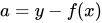
![L_{\delta }(y,f(x))={\begin{cases}{\frac {1}{2}}{\left(y-f(x)\right)}^{2}&{\text{for }}\left|y-f(x)\right|\leq \delta ,\\[4pt]\delta \ \cdot \left(\left|y-f(x)\right|-{\frac {1}{2}}\delta \right),&{\text{otherwise.}}\end{cases}}](https://wikimedia.org/api/rest_v1/media/math/render/svg/a24b2cea89d6b001c7d6ba1345e4d7dbb40df786)
The Huber loss is the convolution of the absolute value function with the rectangular function, scaled and translated. Thus it "smoothens out" the former's corner at the origin.

02Motivation
Two very commonly used loss functions are the squared loss, 


As defined above, the Huber loss function is strongly convex in a uniform neighborhood of its minimum 


03Pseudo-Huber loss function
The Pseudo-Huber loss function can be used as a smooth approximation of the Huber loss function. It combines the best properties of L2 squared loss and L1 absolute loss by being strongly convex when close to the target/minimum and less steep for extreme values. The scale at which the Pseudo-Huber loss function transitions from L2 loss for values close to the minimum to L1 loss for extreme values and the steepness at extreme values can be controlled by the 

As such, this function approximates 
While the above is the most common form, other smooth approximations of the Huber loss function also exist.

04Variant for classification
For classification purposes, a variant of the Huber loss called modified Huber is sometimes used. Given a prediction 
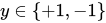
![L(y,f(x))={\begin{cases}\max(0,1-y\,f(x))^{2}&{\text{for }}\,\,y\,f(x)>-1,\\[4pt]-4y\,f(x)&{\text{otherwise.}}\end{cases}}](https://wikimedia.org/api/rest_v1/media/math/render/svg/668223cca6f51102f16f0c78b9b56922493be9cc)
The term 

05Applications
The Huber loss function is used in robust statistics, M-estimation and additive modelling.
Sources and credits
This article is adapted from the Wikipedia article “Huber loss”, written by its contributors and licensed under CC BY-SA 4.0. Fathomly has changed the layout, removed citation markers, navigation and maintenance notices, and adjusted punctuation. This adapted version is shared under the same license. For references, see the original article.
Images, from Wikimedia Commons:
- Huber loss.svg by Qwertyus, CC BY-SA 4.0
- Comparison of loss functions.png by M.Zkuba, CC BY-SA 4.0
Fathomly is not affiliated with or endorsed by the Wikimedia Foundation. Spotted a problem? Tell us.