Additive model
Statistical regression model
In statistics, an additive model (AM) is a nonparametric regression method. It was suggested by Jerome H. Friedman and Werner Stuetzle (1981) and is an essential part of the ACE algorithm. The AM uses a one-dimensional smoother to build a restricted class of nonparametric regression models. Because of this, it is less affected by the curse of dimensionality than a p-dimensional smoother. Furthermore, the AM is more flexible than a standard linear model, while being more interpretable than a general regression surface at the cost of approximation errors. Problems with AM, like many other machine-learning methods, include model selection, overfitting, and multicollinearity.
01Description
Given a data set 


![\mathrm {E} [y_{i}|x_{i1},\ldots ,x_{ip}]=\beta _{0}+\sum _{j=1}^{p}f_{j}(x_{ij})](https://wikimedia.org/api/rest_v1/media/math/render/svg/81d5cc6bcb970849325c676648504fa8a39a763b)
or
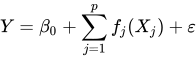
Where ![\mathrm {E} [\epsilon ]=0](https://wikimedia.org/api/rest_v1/media/math/render/svg/f7494dee92fe5ac5a8d8a61fa72e73482ad679d9)

![\mathrm {E} [f_{j}(X_{j})]=0](https://wikimedia.org/api/rest_v1/media/math/render/svg/ebc45cdd662236cf2546a2a70c1c03383d50ac3a)

Sources and credits
This article is adapted from the Wikipedia article “Additive model”, written by its contributors and licensed under CC BY-SA 4.0. Fathomly has changed the layout, removed citation markers, navigation and maintenance notices, and adjusted punctuation. This adapted version is shared under the same license. For references, see the original article.
Fathomly is not affiliated with or endorsed by the Wikimedia Foundation. Spotted a problem? Tell us.