Groupoid
Category where every morphism is invertible; generalization of a group
In mathematics, especially in category theory and homotopy theory, a groupoid (less often Brandt groupoid or virtual group) generalises the notion of group in several equivalent ways. A groupoid can be seen as a:
- Group with a partial function replacing the binary operation;
- Category in which every morphism is invertible. A category of this sort can be viewed as augmented with a unary operation on the morphisms, called inverse by analogy with group theory. A groupoid where there is only one object is a usual group.
In the presence of dependent typing, a category in general can be viewed as a typed monoid, and similarly, a groupoid can be viewed as simply a typed group. The morphisms take one from one object to another, and form a dependent family of types, thus morphisms might be typed 



Special cases include:
- Setoid: a set that comes with an equivalence relation,
- G-set: a set equipped with an action of a group
.
Groupoids are often used to reason about geometrical objects such as manifolds. Heinrich Brandt (1927) introduced groupoids implicitly via Brandt semigroups.
01Definitions
Algebraic
A groupoid can be viewed as an algebraic structure consisting of a set with a binary partial function. Precisely, it is a non-empty set 


The operations 


- Associativity: If
and
are defined, then
and
are defined and are equal. Conversely, if one of
- Inverse:
and
are always defined.
- Identity: If
, and
. (The previous two axioms already show that these expressions are defined and unambiguous.)
Two convenient properties follow from these axioms:
-
,
- If
.
Category-theoretic
A groupoid is a small category in which every morphism is an isomorphism, i.e., invertible. More explicitly, a groupoid 
- for each pair of objects
and
, a (possibly empty) set
of morphisms (or arrows) from
to indicate that
is an element of
- for each triple of objects
, a function
that is associative. That is, for every four objects
and functions
- for every object
of
satisfying, for any morphism
-
and
;
-
- for each pair of objects
satisfying, for any
and
.

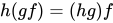
If the requirement that inverses exist is removed while keeping everything else, this is then the definition of a category. Thus, a groupoid is a category in which every morphism has an inverse.
If 

A groupoid 


More generally, one can consider a groupoid object in an arbitrary category admitting finite fiber products.
Comparing the definitions
The algebraic and category-theoretic definitions are equivalent, as we now show. Given a groupoid in the category-theoretic sense, let 


Conversely, given a groupoid 


Now define 







Sets in the definitions above may be replaced with classes, as is generally the case in category theory.
Vertex groups and orbits
Given a groupoid
The orbit of a groupoid 
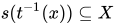


Orbits form a partition of the set 
Subgroupoids and morphisms
A subgroupoid of 


A groupoid morphism is simply a functor between two (category-theoretic) groupoids.
Particular kinds of morphisms of groupoids are of interest. A morphism 


It is also true that the category of covering morphisms of a given groupoid
02Examples
Every group is a groupoid.
Fundamental groupoid
Given a topological space 


The orbits of the fundamental groupoid
An important extension of this idea is to consider the fundamental groupoid 


Equivalence relation
If
- The objects of the groupoid are the elements of
- For any two elements
) if and only if
;
- The composition of
and
.
The vertex groups of this groupoid are always trivial; moreover, this groupoid is in general not transitive and its orbits are precisely the equivalence classes. There are two extreme examples:
- If every element of
as set of arrows, and which is transitive.
- If every element of
, and which is completely intransitive (every singleton
is an orbit).
Examples
- If
is a smooth surjective submersion of smooth manifolds, then
is an equivalence relation since
has a topology isomorphic to the quotient topology of
under the surjective map of topological spaces. If we write,
then we get a groupoid
which is sometimes called the banal groupoid of a surjective submersion of smooth manifolds.
- If we relax the reflexivity requirement and consider partial equivalence relations, then it becomes possible to consider semidecidable notions of equivalence on computable realisers for sets. This allows groupoids to be used as a computable approximation to set theory, called PER models. Considered as a category, PER models are a cartesian closed category with natural numbers object and subobject classifier, giving rise to the effective topos introduced by Martin Hyland.
Čech groupoid
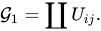
A Čech groupoid p. 5 is a special kind of groupoid associated to an equivalence relation given by an open cover 

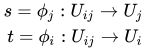
The source and target maps are then given by the induced maps
and the inclusion map

giving the structure of a groupoid. In fact, this can be further extended by setting

as the 

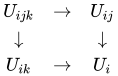
is a cartesian diagram where the maps to 


![[\sigma ]\in {\check {H}}^{k}({\mathcal {U}},{\underline {A}})](https://wikimedia.org/api/rest_v1/media/math/render/svg/a4d80e00b1963ce9610eb17e06c5acf1d845dc36)
for some constant sheaf of abelian groups can be represented as a function
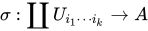
giving an explicit representation of cohomology classes.
Group action
If the group
- The objects are the elements of
- For any two elements
of
;
- Composition of morphisms interprets the binary operation of
More explicitly, the action groupoid is a small category with 




For 

Another way to describe ![[\mathrm {Gr} ,\mathrm {Set} ]](https://wikimedia.org/api/rest_v1/media/math/render/svg/d202986fe949389c72ace55d27a31e5d854e7bb6)


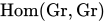
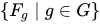
Finite set
Consider the group action of 



![[X/G]](https://wikimedia.org/api/rest_v1/media/math/render/svg/6c10708eac95ed8fcce0dd132f18c6d844536ebf)
![\{[0],[1],[2]\}](https://wikimedia.org/api/rest_v1/media/math/render/svg/545b64b67ed310d77a2ad586f9ff333ae5fdf298)
![[0]](https://wikimedia.org/api/rest_v1/media/math/render/svg/ee314d016dd522b7f685325ca45f5e5003081fd0)
Quotient variety
Any finite group 

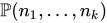
![[\mathbb {A} ^{n}/G]](https://wikimedia.org/api/rest_v1/media/math/render/svg/7480af765bbd0c13aae7ca9014c1eddc06b272bf)
Inertia groupoid
The inertia groupoid of a groupoid is roughly a groupoid of loops in the given groupoid.
Fiber product of groupoids
Given a diagram of groupoids with groupoid morphisms

where 









Homological algebra
A two term complex

of objects in a concrete Abelian category can be used to form a groupoid. It has as objects the set 




Of course, if the abelian category is the category of coherent sheaves on a scheme, then this construction can be used to form a presheaf of groupoids.
Puzzles
While puzzles such as the Rubik's Cube can be modeled using group theory (see Rubik's Cube group), certain puzzles are better modeled as groupoids.
The transformations of the fifteen puzzle form a groupoid (not a group, as not all moves can be composed). This groupoid acts on configurations.
Mathieu groupoid
The Mathieu groupoid is a groupoid introduced by John Horton Conway acting on 13 points such that the elements fixing a point form a copy of the Mathieu group M12.
03Relation to groups
| Total | Associative | Identity | Divisible | |
|---|---|---|---|---|
| Partial magma | Unneeded | Unneeded | Unneeded | Unneeded |
| Multiplicative | Unneeded | Unneeded | Required | Unneeded |
| Semigroupoid | Unneeded | Required | Unneeded | Unneeded |
| Small category | Unneeded | Required | Required | Unneeded |
| Groupoid | Unneeded | Required | Required | Required |
| Magma | Required | Unneeded | Unneeded | Unneeded |
| Quasigroup | Required | Unneeded | Unneeded | Required |
| Unital magma | Required | Unneeded | Required | Unneeded |
| Loop | Required | Unneeded | Required | Required |
| Semigroup | Required | Required | Unneeded | Unneeded |
| Associative quasigroup | Required | Required | Unneeded | Required |
| Monoid | Required | Required | Required | Unneeded |
| Group | Required | Required | Required | Required |
If a groupoid has only one object, then the set of its morphisms forms a group. Using the algebraic definition, such a groupoid is literally just a group. Many concepts of group theory generalize to groupoids, with the notion of functor replacing that of group homomorphism.
Every transitive/connected groupoid - that is, as explained above, one in which any two objects are connected by at least one morphism - is isomorphic to an action groupoid (as defined above) 
Note that the isomorphism just mentioned is not unique, and there is no natural choice. Choosing such an isomorphism for a transitive groupoid essentially amounts to picking one object 


If a groupoid is not transitive, then it is isomorphic to a disjoint union of groupoids of the above type, also called its connected components (possibly with different groups
In category-theoretic terms, each connected component of a groupoid is equivalent (but not isomorphic) to a groupoid with a single object, that is, a single group. Thus any groupoid is equivalent to a multiset of unrelated groups. In other words, for equivalence instead of isomorphism, one does not need to specify the sets
- The fundamental groupoid of
- The set
- The set
The collapse of a groupoid into a mere collection of groups loses some information, even from a category-theoretic point of view, because it is not natural. Thus when groupoids arise in terms of other structures, as in the above examples, it can be helpful to maintain the entire groupoid. Otherwise, one must choose a way to view each
As a more illuminating example, the classification of groupoids with one endomorphism does not reduce to purely group theoretic considerations. This is analogous to the fact that the classification of vector spaces with one endomorphism is nontrivial.
Morphisms of groupoids come in more kinds than those of groups: we have, for example, fibrations, covering morphisms, universal morphisms, and quotient morphisms. Thus a subgroup 

04Category of groupoids
The category whose objects are groupoids and whose morphisms are groupoid morphisms is called the groupoid category, or the category of groupoids, and is denoted by Grpd.
The category Grpd is, like the category of small categories, Cartesian closed: for any groupoids 



This adjunction is of interest even if all the groupoids
Another important property of Grpd is that it is both complete and cocomplete.
Relation to Cat
The inclusion 
![\hom _{\mathbf {Grpd} }(C[C^{-1}],G)\cong \hom _{\mathbf {Cat} }(C,i(G))](https://wikimedia.org/api/rest_v1/media/math/render/svg/aba2ef04dc7f96b977927c6013566ad91d5f9043)

Here, ![C[C^{-1}]](https://wikimedia.org/api/rest_v1/media/math/render/svg/c1c43d3d93f9220c3bcc73a2c8a9093ebb2e2b03)

Relation to sSet
The nerve functor 
The nerve has a left adjoint

Here,
Groupoids in Grpd
There is an additional structure which can be derived from groupoids internal to the category of groupoids, double-groupoids. Because Grpd is a 2-category, these objects form a 2-category instead of a 1-category since there is extra structure. Essentially, these are groupoids 

and an embedding given by an identity functor

One way to think about these 2-groupoids is they contain objects, morphisms, and squares which can compose together vertically and horizontally. For example, given squares
and

with
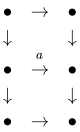
which can be converted into another square by composing the vertical arrows. There is a similar composition law for horizontal attachments of squares.
05Groupoids with geometric structures
When studying geometrical objects, the arising groupoids often carry a topology, turning them into topological groupoids, or even some differentiable structure, turning them into Lie groupoids. These last objects can be also studied in terms of their associated Lie algebroids, in analogy to the relation between Lie groups and Lie algebras.
Groupoids arising from geometry often possess further structures which interact with the groupoid multiplication. For instance, in Poisson geometry one has the notion of a symplectic groupoid, which is a Lie groupoid endowed with a compatible symplectic form. Similarly, one can have groupoids with a compatible Riemannian metric, or complex structure, etc.
Sources and credits
This article is adapted from the Wikipedia article “Groupoid”, written by its contributors and licensed under CC BY-SA 4.0. Fathomly has changed the layout, removed citation markers, navigation and maintenance notices, and adjusted punctuation. This adapted version is shared under the same license. For references, see the original article.
Fathomly is not affiliated with or endorsed by the Wikimedia Foundation. Spotted a problem? Tell us.
