Google matrix
Stochastic matrix representing links between entities

A Google matrix is a particular stochastic matrix that is used by Google's PageRank algorithm. The matrix represents a graph with edges representing links between pages. The PageRank of each page can then be generated iteratively from the Google matrix using the power method. However, in order for the power method to converge, the matrix must be stochastic, irreducible and aperiodic.
01Adjacency matrix A and Markov matrix S
In order to generate the Google matrix G, we must first generate an adjacency matrix A which represents the relations between pages or nodes.
Assuming there are N pages, we can fill out A by doing the following:
- A matrix element
is filled with 1 if node
has a link to node
, and 0 otherwise; this is the adjacency matrix of links.
- A related matrix S corresponding to the transitions in a Markov chain of given network is constructed from A by dividing the elements of column "j" by a number of
where
is the total number of outgoing links from node j to all other nodes. The columns having zero matrix elements, corresponding to dangling nodes, are replaced by a constant value 1/N. Such a procedure adds a link from every sink, dangling state
to every other node.
- Now by the construction the sum of all elements in any column of matrix S is equal to unity. In this way the matrix S is mathematically well defined and it belongs to the class of Markov chains and the class of Perron-Frobenius operators. That makes S suitable for the PageRank algorithm.

02Construction of Google matrix G
Then the final Google matrix G can be expressed via S as:

By the construction the sum of all non-negative elements inside each matrix column is equal to unity. The numerical coefficient 
Usually S is a sparse matrix and for modern directed networks it has only about ten nonzero elements in a line or column, thus only about 10N multiplications are needed to multiply a vector by matrix G.

03Examples of Google matrix
An example of the matrix 
For the actual matrix, Google uses a damping factor 

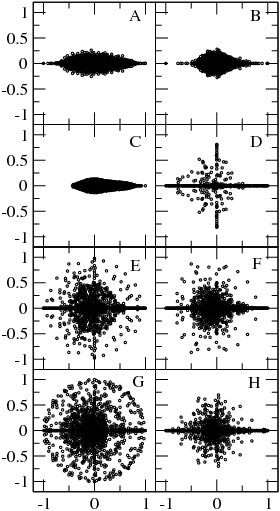
04Spectrum and eigenstates of G matrix
For 






At 
The Google matrix can be also constructed for the Ulam networks generated by the Ulam method [8] for dynamical maps. The spectral properties of such matrices are discussed in [9,10,11,12,13,15]. In a number of cases the spectrum is described by the fractal Weyl law [10,12].
The Google matrix can be constructed also for other directed networks, e.g. for the procedure call network of the Linux Kernel software introduced in [15]. In this case the spectrum of 

Other examples of

05Historical notes
The Google matrix with damping factor was described by Sergey Brin and Larry Page in 1998 [22], see also articles on PageRank history [23], [24].

Sources and credits
This article is adapted from the Wikipedia article “Google matrix”, written by its contributors and licensed under CC BY-SA 4.0. Fathomly has changed the layout, removed citation markers, navigation and maintenance notices, and adjusted punctuation. This adapted version is shared under the same license. For references, see the original article.
Images, from Wikimedia Commons:
- Googlematrixcambridge2006spectrum.gif by Unknown author, CC-BY-SA-3.0
- Googlematrixwikipedia2009.jpg by Unknown author, GFDL
- Googlematrixcambridge2006.jpg by Unknown author, GFDL
- Googlematrix1.jpg by Shepelyansky, Public domain
- Googlematrix2.jpg by L.Ermann, A.D.Chepelianskii and D.L.Shepelyansky, CC0
- Googlematrix3.gif by Shepelyansky, CC0
Fathomly is not affiliated with or endorsed by the Wikimedia Foundation. Spotted a problem? Tell us.

