CheiRank
Metric used to rank web pages

The CheiRank is an eigenvector with a maximal real eigenvalue of the Google matrix constructed for a directed network with the inverted link directions. It is complementary to the PageRank vector, which ranks nodes based on their number of incoming links. Due to the inversion of link directions CheiRank measures a node's outgoing connectivity. Combining both vectors yields two-dimensional ranking of information flow across a directed network.
01Definition
For a given directed network the Google matrix is constructed in the way described in the article Google matrix. The PageRank vector is the eigenvector with the maximal real eigenvalue . It was introduced in and is discussed in the article PageRank. In a similar way the CheiRank is the eigenvector with the maximal real eigenvalue of the matrix
built in the same way as
but using inverted direction of links in the initially given adjacency matrix. Both matrices
and
belong to the class of Perron-Frobenius operators and according to the Perron-Frobenius theorem the CheiRank
and PageRank
eigenvectors have nonnegative components which can be interpreted as probabilities. Thus all
nodes
of the network can be ordered in a decreasing probability order with ranks
for CheiRank and PageRank
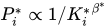
respectively. In average the PageRank probability
is proportional to the number of ingoing links with
. For the World Wide Web (WWW) network the exponent
where
is the exponent for ingoing links distribution. In a similar way the CheiRank probability is in average proportional to the number of outgoing links with
with
where
is the exponent for outgoing links distribution of the WWW. The CheiRank was introduced for the procedure call network of Linux Kernel software in, the term itself was used in Zhirov. While the PageRank highlights very well known and popular nodes, the CheiRank highlights very communicative nodes. Top PageRank and CheiRank nodes have certain analogy to authorities and hubs appearing in the HITS algorithm but the HITS is query dependent while the rank probabilities
and
classify all nodes of the network. Since each node belongs both to CheiRank and PageRank we obtain a two-dimensional ranking of network nodes. There had been early studies of PageRank in networks with inverted direction of links but the properties of two-dimensional ranking had not been analyzed in detail.


02Examples
An example of nodes distribution in the plane of PageRank and CheiRank is shown in Fig.1 for the procedure call network of Linux Kernel software.
The dependence of on
for the network of hyperlink network of Wikipedia English articles is shown in Fig.2 from Zhirov. The distribution of these articles in the plane of PageRank and CheiRank is shown in Fig.3 from Zhirov. The difference between PageRank and CheiRank is clearly seen from the names of Wikipedia articles (2009) with highest rank. At the top of PageRank we have 1.United States, 2.United Kingdom, 3.France while for CheiRank we find 1.Portal:Contents/Outline of knowledge/Geography and places, 2.List of state leaders by year, 3.Portal:Contents/Index/Geography and places. Clearly PageRank selects first articles on a broadly known subject with a large number of ingoing links while CheiRank selects first highly communicative articles with many outgoing links. Since the articles are distributed in 2D they can be ranked in various ways corresponding to projection of 2D set on a line. The horizontal and vertical lines correspond to PageRank and CheiRank, 2DRank combines properties of CheiRank and PageRank as it is discussed in Zhirov. It gives top Wikipedia articles 1.India, 2.Singapore, 3.Pakistan.
The 2D ranking highlights the properties of Wikipedia articles in a new rich and fruitful manner. According to the PageRank the top 100 personalities described in Wikipedia articles have in 5 main category activities: 58 (politics), 10 (religion),17 (arts), 15 (science), 0 (sport) and thus the importance of politicians is strongly overestimated. The CheiRank gives respectively 15, 1, 52, 16, 16 while for 2DRank one finds 24, 5, 62, 7, 2. Such type of 2D ranking can find useful applications for various complex directed networks including the WWW.
CheiRank and PageRank naturally appear for the world trade network, or international trade, where they and linked with export and import flows for a given country respectively.
Possibilities of development of two-dimensional search engines based on PageRank and CheiRank are considered. Directed networks can be characterized by the correlator between PageRank and CheiRank vectors: in certain networks this correlator is close to zero (e.g. Linux Kernel network) while other networks have large correlator values (e.g. Wikipedia or university networks).


03Simple network example
A simple example of the construction of the Google matrices and
, used for determination of the related PageRank and CheiRank vectors, is given below. The directed network example with 7 nodes is shown in Fig.4. The matrix
, built with the rules described
in the article Google matrix, is shown in Fig.5;
the related Google matrix is
and the PageRank vector is the right eigenvector of
with the unit eigenvalue (
). In a similar way, to determine the CheiRank eigenvector all directions of links in Fig.4 are inverted,
then the matrix
is built,
according to the same rules applied for the network with inverted link
directions, as shown in Fig.6. The related Google matrix is
and the CheiRank vector
is the right eigenvector of
with the unit eigenvalue (
). Here
is the damping factor taken at its usual value.


Sources and credits
This article is adapted from the Wikipedia article “CheiRank”, written by its contributors and licensed under CC BY-SA 4.0. Fathomly has changed the layout, removed citation markers, navigation and maintenance notices, and adjusted punctuation. This adapted version is shared under the same license. For references, see the original article.
Images, from Wikimedia Commons:
- CheiRank1.jpg by Alexei D. Chepelianskii, GFDL
- CheiRank4.jpg by Shepelyansky (talk) (Uploads), CC-BY-SA-3.0
- CheiRank5.jpg by Shepelyansky (talk) (Uploads), CC-BY-SA-3.0
- CheiPageRank.png by Shepelyansky, Public domain
- CheiRank2.jpg by Shepelyansky, Public domain
- CheiRank3.jpg by Shepelyansky, Public domain
- CheiRank6.jpg by Shepelyansky (talk) (Uploads), CC BY-SA 3.0
Fathomly is not affiliated with or endorsed by the Wikimedia Foundation. Spotted a problem? Tell us.