Fox-Wright function
Generalisation of the generalised hypergeometric function pFq(z)
In mathematics, the Fox-Wright function (also known as Fox-Wright Psi function, not to be confused with Wright Omega function) is a generalisation of the generalised hypergeometric function pFq(z) based on ideas of Charles Fox (1928) and E. Maitland Wright (1935):
![{}_{p}\Psi _{q}\left[{\begin{matrix}(a_{1},A_{1})&(a_{2},A_{2})&\ldots &(a_{p},A_{p})\\(b_{1},B_{1})&(b_{2},B_{2})&\ldots &(b_{q},B_{q})\end{matrix}};z\right]=\sum _{n=0}^{\infty }{\frac {\Gamma (a_{1}+A_{1}n)\cdots \Gamma (a_{p}+A_{p}n)}{\Gamma (b_{1}+B_{1}n)\cdots \Gamma (b_{q}+B_{q}n)}}\,{\frac {z^{n}}{n!}}.](https://wikimedia.org/api/rest_v1/media/math/render/svg/9ab45ae4b1283978ae4ccb07a7a46a36957d9fb4)
Upon changing the normalisation
![{}_{p}\Psi _{q}^{*}\left[{\begin{matrix}(a_{1},A_{1})&(a_{2},A_{2})&\ldots &(a_{p},A_{p})\\(b_{1},B_{1})&(b_{2},B_{2})&\ldots &(b_{q},B_{q})\end{matrix}};z\right]={\frac {\Gamma (b_{1})\cdots \Gamma (b_{q})}{\Gamma (a_{1})\cdots \Gamma (a_{p})}}\sum _{n=0}^{\infty }{\frac {\Gamma (a_{1}+A_{1}n)\cdots \Gamma (a_{p}+A_{p}n)}{\Gamma (b_{1}+B_{1}n)\cdots \Gamma (b_{q}+B_{q}n)}}\,{\frac {z^{n}}{n!}}](https://wikimedia.org/api/rest_v1/media/math/render/svg/b2c530d8bd1ce434141c9d2b83eb3c98d9b22fa0)
it becomes pFq(z) for A1...p = B1...q = 1.
The Fox-Wright function is a special case of the Fox H-function (Srivastava & Manocha 1984, p. 50):
![{}_{p}\Psi _{q}\left[{\begin{matrix}(a_{1},A_{1})&(a_{2},A_{2})&\ldots &(a_{p},A_{p})\\(b_{1},B_{1})&(b_{2},B_{2})&\ldots &(b_{q},B_{q})\end{matrix}};z\right]=H_{p,q+1}^{1,p}\left[-z\left|{\begin{matrix}(1-a_{1},A_{1})&(1-a_{2},A_{2})&\ldots &(1-a_{p},A_{p})\\(0,1)&(1-b_{1},B_{1})&(1-b_{2},B_{2})&\ldots &(1-b_{q},B_{q})\end{matrix}}\right.\right].](https://wikimedia.org/api/rest_v1/media/math/render/svg/ffe83e472f89f4a998dc750566a980c28def03b3)
01Wright function
The entire function 
![{}_{0}\Psi _{1}\left[\ldots \right]](https://wikimedia.org/api/rest_v1/media/math/render/svg/3d4d213f41c4cbec3b33408d2c2e338039817259)

This function is used extensively in fractional calculus. Recall that 


Three properties were stated in Theorem 1 of Wright (1933) and 18.1(30-32) of Erdelyi, Bateman Project, Vol 3 (1955) (p. 212)
![{\begin{aligned}\lambda zW_{\lambda ,\mu +\lambda }(z)&=W_{\lambda ,\mu -1}(z)+(1-\mu )W_{\lambda ,\mu }(z)&(a)\\[6pt]{d \over dz}W_{\lambda ,\mu }(z)&=W_{\lambda ,\mu +\lambda }(z)&(b)\\[6pt]\lambda z{d \over dz}W_{\lambda ,\mu }(z)&=W_{\lambda ,\mu -1}(z)+(1-\mu )W_{\lambda ,\mu }(z)&(c)\end{aligned}}](https://wikimedia.org/api/rest_v1/media/math/render/svg/a07b7f942cb218ae53fc4b1889e67096fc264977)
Equation (a) is a recurrence formula. (b) and (c) provide two paths to reduce a derivative. And (c) can be derived from (a) and (b).
A special case of (c) is 


![{\begin{array}{lcl}x{d \over dx}W_{-c\alpha ,0}(-x^{\alpha })&=&-{\frac {1}{c}}\left[W_{-c\alpha ,-1}(-x^{\alpha })+W_{-c\alpha ,0}(-x^{\alpha })\right]\end{array}}](https://wikimedia.org/api/rest_v1/media/math/render/svg/bfe07892a2fb601ec2f29988305f4a2beda9a29a)
A special case of (a) is 


Two notations, 

![{\begin{aligned}M_{\alpha }(z)&=W_{-\alpha ,1-\alpha }(-z),\\[1ex]\implies F_{\alpha }(z)&=W_{-\alpha ,0}(-z)=\alpha zM_{\alpha }(z).\end{aligned}}](https://wikimedia.org/api/rest_v1/media/math/render/svg/97ecbfca463abbfd3d327dfa481c9acc621f7f7d)
M-Wright function
Its properties were surveyed in Mainardi et al (2010).
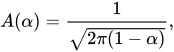
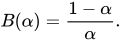
Its asymptotic expansion of 

Sources and credits
This article is adapted from the Wikipedia article “Fox-Wright function”, written by its contributors and licensed under CC BY-SA 4.0. Fathomly has changed the layout, removed citation markers, navigation and maintenance notices, and adjusted punctuation. This adapted version is shared under the same license. For references, see the original article.
Fathomly is not affiliated with or endorsed by the Wikimedia Foundation. Spotted a problem? Tell us.

