Prabhakar function
Prabhakar function is a certain special function in mathematics introduced by the Indian mathematician Tilak Raj Prabhakar in a paper published in 1971. The function is a three-parameter generalization of the well known two-parameter Mittag-Leffler function in mathematics. The function was originally introduced to solve certain classes of integral equations. Later the function was found to have applications in the theory of fractional calculus and also in certain areas of physics.
01Definition
The one-parameter and two-parameter Mittag-Leffler functions are defined first. Then the definition of the three-parameter Mittag-Leffler function, the Prabhakar function, is presented. In the following definitions, 
.
In the following it will be assumed that 


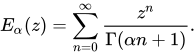
One-parameter Mittag-Leffler function
The one-parameter Mittag-Leffler function is defined as
Two-parameter Mittag-Leffler function
The two-parameter Mittag-Leffler function is defined as

Three-parameter Mittag-Leffler function (Prabhakar function)
The three-parameter Mittag-Leffler function (Prabhakar function) is defined by

where 
02Elementary special cases
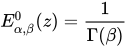
The following special cases immediately follow from the definition.
, the two-parameter Mittag-Leffler function.
, the one-parameter Mittag-Leffler function.
, the classical exponential function.
03Properties
Reduction formula
The following formula can be reduced to lower the value of the third parameter
![E_{\alpha ,\beta }^{\gamma +1}(z)={\frac {1}{\alpha \gamma }}{\big [}E_{\alpha ,\beta -1}^{\gamma }(z)+(1-\beta +\alpha \gamma )E_{\alpha ,\beta }^{\gamma }(z){\big ]}](https://wikimedia.org/api/rest_v1/media/math/render/svg/9802b106c25664305df306d3b3915d67b8699ef6)
Relation with Fox-Wright function
The Prabhakar function is related to the Fox-Wright function by the following relation:

Derivatives
The derivative of the Prabhakar function is given by
![{\frac {d}{dz}}\left(E_{\alpha ,\beta }^{\gamma }(z)\right)={\frac {1}{\alpha z}}{\big [}E_{\alpha ,\beta -1}^{\gamma }(z)+(1-\beta )E_{\alpha ,\beta }^{\gamma }{\big ]}](https://wikimedia.org/api/rest_v1/media/math/render/svg/3719dba01f7ff5122eed40f846db65d918b60138)
There is a general expression for higher order derivatives. Let 

The following result is useful in applications.

Integrals
The following result involving Prabhakar function is known.

Laplace transforms
The following result involving Laplace transforms plays an important role in both physical applications and numerical computations of the Prabhakar function.
![L\left[t^{\beta -1}E_{\alpha ,\beta }^{\gamma }(t^{\alpha }z)\,;\,s\right]={\frac {s^{\alpha \gamma -\beta }}{(s^{\alpha }-z)^{\gamma }}},\quad \Re (s)>0,\quad |s|>|z|^{1/\alpha }](https://wikimedia.org/api/rest_v1/media/math/render/svg/1e240d3462a7b403ef214dfa8c509798e161b9d1)
04Prabhakar fractional calculus
The following function is known as the Prabhakar kernel in the literature.

Given any function 

Properties of the Prabhakar fractional integral have been extensively studied in the literature.
Sources and credits
This article is adapted from the Wikipedia article “Prabhakar function”, written by its contributors and licensed under CC BY-SA 4.0. Fathomly has changed the layout, removed citation markers, navigation and maintenance notices, and adjusted punctuation. This adapted version is shared under the same license. For references, see the original article.
Fathomly is not affiliated with or endorsed by the Wikimedia Foundation. Spotted a problem? Tell us.