Compound Poisson distribution
Aspect of probability theory
In probability theory, a compound Poisson distribution is the probability distribution of the sum of a number of independent identically-distributed random variables, where the number of terms to be added is itself a Poisson-distributed variable. The result can be either a continuous or a discrete distribution.
01Definition
Suppose that

i.e., N is a random variable whose distribution is a Poisson distribution with expected value λ, and that
are identically distributed random variables that are mutually independent and also independent of N. Then the probability distribution of the sum of 

is a compound Poisson distribution.
In the case N = 0, then this is a sum of 0 terms, so the value of Y is 0. Hence the conditional distribution of Y given that N = 0 is a degenerate distribution.
The compound Poisson distribution is obtained by marginalising the joint distribution of (Y,N) over N, and this joint distribution can be obtained by combining the conditional distribution Y | N with the marginal distribution of N.
02Properties
The expected value and the variance of the compound distribution can be derived in a simple way from law of total expectation and the law of total variance. Thus
![\operatorname {E} (Y)=\operatorname {E} \left[\operatorname {E} (Y\mid N)\right]=\operatorname {E} \left[N\operatorname {E} (X)\right]=\operatorname {E} (N)\operatorname {E} (X),](https://wikimedia.org/api/rest_v1/media/math/render/svg/dbf2d81ae11e7ddc4afcc40b8d46bad75382f0f3)
![{\begin{aligned}\operatorname {Var} (Y)&=\operatorname {E} \left[\operatorname {Var} (Y\mid N)\right]+\operatorname {Var} \left[\operatorname {E} (Y\mid N)\right]=\operatorname {E} \left[N\operatorname {Var} (X)\right]+\operatorname {Var} \left[N\operatorname {E} (X)\right],\\[6pt]&=\operatorname {E} (N)\operatorname {Var} (X)+\left(\operatorname {E} (X)\right)^{2}\operatorname {Var} (N).\end{aligned}}](https://wikimedia.org/api/rest_v1/media/math/render/svg/d33fcad106778ee27d263e162f8e9622802a104c)
Then, since E(N) = Var(N) if N is Poisson-distributed, these formulae can be reduced to


The probability distribution of Y can be determined in terms of characteristic functions:

and hence, using the probability-generating function of the Poisson distribution, we have

An alternative approach is via cumulant generating functions:
![K_{Y}(t)=\ln \operatorname {E} [e^{tY}]=\ln \operatorname {E} [\operatorname {E} [e^{tY}\mid N]]=\ln \operatorname {E} [e^{NK_{X}(t)}]=K_{N}(K_{X}(t)).\,](https://wikimedia.org/api/rest_v1/media/math/render/svg/74ece4e0371220b60b44eff6c31b2cd931556ab5)
Via the law of total cumulance it can be shown that, if the mean of the Poisson distribution λ = 1, the cumulants of Y are the same as the moments of X1.
Every infinitely divisible probability distribution is a limit of compound Poisson distributions. And compound Poisson distributions is infinitely divisible by the definition.
03Discrete compound Poisson distribution
When 



has a discrete compound Poisson(DCP) distribution with parameters 



Moreover, if 


Feller's characterization of the compound Poisson distribution states that a non-negative integer valued r.v.
This distribution can model batch arrivals (such as in a bulk queue). The discrete compound Poisson distribution is also widely used in actuarial science for modelling the distribution of the total claim amount.
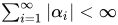
When some 

has a discrete pseudo compound Poisson distribution with parameters 


04Compound Poisson Gamma distribution
If X has a gamma distribution, of which the exponential distribution is a special case, then the conditional distribution of Y | N is again a gamma distribution. The marginal distribution of Y is a Tweedie distribution with variance power 1 < p < 2 (proof via comparison of characteristic function). To be more explicit, if
and
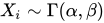
i.i.d., then the distribution of

is a reproductive exponential dispersion model 
![{\begin{aligned}\operatorname {E} [Y]&=\lambda {\frac {\alpha }{\beta }}=:\mu ,\\[4pt]\operatorname {Var} [Y]&=\lambda {\frac {\alpha (1+\alpha )}{\beta ^{2}}}=:\sigma ^{2}\mu ^{p}.\end{aligned}}](https://wikimedia.org/api/rest_v1/media/math/render/svg/32374b314484c515652fe03a0dc0898bfc2a057c)
The mapping of parameters Tweedie parameter 

![{\begin{aligned}\lambda &={\frac {\mu ^{2-p}}{(2-p)\sigma ^{2}}},\\[4pt]\alpha &={\frac {2-p}{p-1}},\\[4pt]\beta &={\frac {\mu ^{1-p}}{(p-1)\sigma ^{2}}}.\end{aligned}}](https://wikimedia.org/api/rest_v1/media/math/render/svg/4a9c48879da7cfbeba555071fd08487d8554c200)
05Compound Poisson processes
A compound Poisson process with rate 

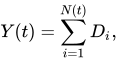
where the sum is by convention equal to zero as long as N(t) = 0. Here, 

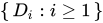

For the discrete version of compound Poisson process, it can be used in survival analysis for the frailty models.
06Applications
A compound Poisson distribution, in which the summands have an exponential distribution, was used by Revfeim to model the distribution of the total rainfall in a day, where each day contains a Poisson-distributed number of events each of which provides an amount of rainfall which has an exponential distribution. Thompson applied the same model to monthly total rainfalls.
There have been applications to insurance claims and x-ray computed tomography.
Sources and credits
This article is adapted from the Wikipedia article “Compound Poisson distribution”, written by its contributors and licensed under CC BY-SA 4.0. Fathomly has changed the layout, removed citation markers, navigation and maintenance notices, and adjusted punctuation. This adapted version is shared under the same license. For references, see the original article.
Fathomly is not affiliated with or endorsed by the Wikimedia Foundation. Spotted a problem? Tell us.

