Completely positive map
C*-algebra mapping preserving positive elements
In mathematics a positive map is a map between C*-algebras that sends positive elements to positive elements. A completely positive map is one that satisfies a stronger, more robust condition.
01Definition
Let 



Any linear map

in a natural way. If 


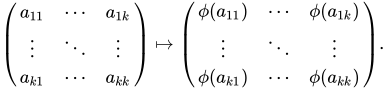
We then say 
02Properties
- Positive maps are monotone, i.e.
for all self-adjoint elements
.
- Since
for all self-adjoint elements
, every positive map is automatically continuous with respect to the C*-norms and its operator norm equals
. A similar statement with approximate units holds for non-unital algebras.
- The set of positive functionals
is the dual cone of the cone of positive elements of
03Examples
- Every *-homomorphism is completely positive.
- For every linear operator
between Hilbert spaces, the map
is completely positive. Stinespring's theorem says that all completely positive maps are compositions of *-homomorphisms and these special maps.
- Every positive functional
(in particular every state) is automatically completely positive.
- Given the algebras
and
of complex-valued continuous functions on compact Hausdorff spaces
, every positive map
is completely positive.
- The transposition of matrices is a standard example of a positive map that fails to be 2-positive. Let T denote this map on
. The following is a positive matrix in
:
The image of this matrix under
is
which is clearly not positive, having determinant −1. Moreover, the eigenvalues of this matrix are 1,1,1 and −1. (This matrix happens to be the Choi matrix of T, in fact.)
Incidentally, a map Φ is said to be co-positive if the composition ΦT is positive. The transposition map itself is a co-positive map.
Sources and credits
This article is adapted from the Wikipedia article “Completely positive map”, written by its contributors and licensed under CC BY-SA 4.0. Fathomly has changed the layout, removed citation markers, navigation and maintenance notices, and adjusted punctuation. This adapted version is shared under the same license. For references, see the original article.
Fathomly is not affiliated with or endorsed by the Wikimedia Foundation. Spotted a problem? Tell us.