Reference articles on history, science, culture and more
Encyclopedia

Positive element

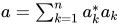
In mathematics, an element of a *-algebra is called positive if it is the sum of elements of the form a^{*}a.

01Definition

Let {\mathcal {A}} be a *-algebra. An element a\in {\mathcal {A}} is called positive if there are finitely many elements a_{k}\in {\mathcal {A}}\;(k=1,2,\ldots ,n), so that {\textstyle a=\sum _{k=1}^{n}a_{k}^{*}a_{k} holds. This is also denoted by a\geq 0.

The set of positive elements is denoted by {\mathcal {A}}_{+}.

A special case from particular importance is the case where {\mathcal {A}} is a complete normed *-algebra, that satisfies the C*-identity (\left\|a^{*}a\right\|=\left\|a\right\|^{2}\ \forall a\in {\mathcal {A}}), which is called a C*-algebra.

02Examples

  • The unit element e of an unital *-algebra is positive.
  • For each element a\in {\mathcal {A}}, the elements a^{*}a and aa^{*} are positive by definition.

In case {\mathcal {A}} is a C*-algebra, the following holds:

03Criteria

Let {\mathcal {A}} be a C*-algebra and a\in {\mathcal {A}}. Then the following are equivalent:

  • For the spectrum \sigma (a)\subseteq [0,\infty ) holds and a is a normal element.
  • There exists an element b\in {\mathcal {A}}, such that a=bb^{*}.
  • There exists a (unique) self-adjoint element c\in {\mathcal {A}}_{sa} such that a=c^{2}.

If {\mathcal {A}} is a unital *-algebra with unit element e, then in addition the following statements are equivalent:

  • \left\|te-a\right\|\leq t for every t\geq \left\|a\right\| and a is a self-adjoint element.
  • \left\|te-a\right\|\leq t for some t\geq \left\|a\right\| and a is a self-adjoint element.

04Properties

In *-algebras

Let {\mathcal {A}} be a *-algebra. Then:

  • If a\in {\mathcal {A}}_{+} is a positive element, then a is self-adjoint.
  • The set of positive elements {\mathcal {A}}_{+} is a convex cone in the real vector space of the self-adjoint elements {\mathcal {A}}_{sa}. This means that \alpha a,a+b\in {\mathcal {A}}_{+} holds for all a,b\in {\mathcal {A}} and \alpha \in [0,\infty ).
  • If a\in {\mathcal {A}}_{+} is a positive element, then b^{*}ab is also positive for every element b\in {\mathcal {A}}.
  • For the linear span of {\mathcal {A}}_{+} the following holds: \langle {\mathcal {A}}_{+}\rangle ={\mathcal {A}}^{2} and {\mathcal {A}}_{+}-{\mathcal {A}}_{+}={\mathcal {A}}_{sa}\cap {\mathcal {A}}^{2}.

In C*-algebras

Let {\mathcal {A}} be a C*-algebra. Then:

  • Using the continuous functional calculus, for every a\in {\mathcal {A}}_{+} and n\in \mathbb {N} there is a uniquely determined b\in {\mathcal {A}}_{+} that satisfies b^{n}=a, i.e. a unique n-th root. In particular, a square root exists for every positive element. Since for every b\in {\mathcal {A}} the element b^{*}b is positive, this allows the definition of a unique absolute value: {\textstyle |b|=(b^{*}b)^{\frac {1}{2}}.
  • For every real number \alpha \geq 0 there is a positive element a^{\alpha }\in {\mathcal {A}}_{+} for which a^{\alpha }a^{\beta }=a^{\alpha +\beta } holds for all \beta \in [0,\infty ). The mapping \alpha \mapsto a^{\alpha } is continuous. Negative values for \alpha are also possible for invertible elements a.
  • Products of positive commutative elements are also positive. So if ab=ba holds for positive a,b\in {\mathcal {A}}_{+}, then ab\in {\mathcal {A}}_{+}.
  • Each element a\in {\mathcal {A}} can be uniquely represented as a linear combination of four positive elements. To do this, a is first decomposed into the self-adjoint real and imaginary parts and these are then decomposed into positive and negative parts using the continuous functional calculus. For it holds that {\mathcal {A}}_{sa}={\mathcal {A}}_{+}-{\mathcal {A}}_{+}, since {\mathcal {A}}^{2}={\mathcal {A}}.
  • If both a and -a are positive a=0 holds.
  • If {\mathcal {B}} is a C*-subalgebra of {\mathcal {A}}, then {\mathcal {B}}_{+}={\mathcal {B}}\cap {\mathcal {A}}_{+}.
  • If {\mathcal {B}} is another C*-algebra and \Phi is a *-homomorphism from {\mathcal {A}} to {\mathcal {B}}, then \Phi ({\mathcal {A}}_{+})=\Phi ({\mathcal {A}})\cap {\mathcal {B}}_{+} holds.
  • If a,b\in {\mathcal {A}}_{+} are positive elements for which ab=0, they commutate and \left\|a+b\right\|=\max(\left\|a\right\|,\left\|b\right\|) holds. Such elements are called orthogonal and one writes a\bot b.

05Partial order

Let {\mathcal {A}} be a *-algebra. The property of being a positive element defines a translation invariant partial order on the set of self-adjoint elements {\mathcal {A}}_{sa}. If b-a\in {\mathcal {A}}_{+} holds for a,b\in {\mathcal {A}}, one writes a\leq b or b\geq a.

This partial order fulfills the properties ta\leq tb and a+c\leq b+c for all a,b,c\in {\mathcal {A}}_{sa} with a\leq b and t\in [0,\infty ).

If {\mathcal {A}} is a C*-algebra, the partial order also has the following properties for a,b\in {\mathcal {A}}:

  • If a\leq b holds, then c^{*}ac\leq c^{*}bc is true for every c\in {\mathcal {A}}. For every c\in {\mathcal {A}}_{+} that commutes with a and b even ac\leq bc holds.
  • If -b\leq a\leq b holds, then \left\|a\right\|\leq \left\|b\right\|.
  • If 0\leq a\leq b holds, then {\textstyle a^{\alpha }\leq b^{\alpha } holds for all real numbers 0<\alpha \leq 1.
  • If a is invertible and 0\leq a\leq b holds, then b is invertible and for the inverses b^{-1}\leq a^{-1} holds.
Watch videos about Positive elementExplainers and documentaries on YouTube (opens in a new tab)

Sources and credits

This article is adapted from the Wikipedia article Positive element, written by its contributors and licensed under CC BY-SA 4.0. Fathomly has changed the layout, removed citation markers, navigation and maintenance notices, and adjusted punctuation. This adapted version is shared under the same license. For references, see the original article.

Fathomly is not affiliated with or endorsed by the Wikimedia Foundation. Spotted a problem? Tell us.