Cardinal function
Function that returns cardinal numbers
In mathematics, a cardinal function (or cardinal invariant) is a function that returns cardinal numbers.
01Cardinal functions in set theory
- The most frequently used cardinal function is the function that assigns to a set A its cardinality, denoted by |A|.
- Aleph numbers and beth numbers can both be seen as cardinal functions defined on ordinal numbers.
- Cardinal arithmetic operations are examples of functions from cardinal numbers (or pairs of them) to cardinal numbers.
- Cardinal characteristics of a (proper) ideal I of subsets of X are:
- The "covering number" of I is the smallest number of sets from I whose union is all of X. As X itself is not in I, we must have add(I ) ≤ cov(I ).
- The "uniformity number" of I (sometimes also written
) is the size of the smallest set not in I. Assuming I contains all singletons, add(I ) ≤ non(I ).
- The "uniformity number" of I (sometimes also written
- The "cofinality" of I is the cofinality of the partial order (I, ⊆). It is easy to see that we must have non(I ) ≤ cof(I ) and cov(I ) ≤ cof(I ).

 ; if I is a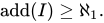



- In the case that
is an ideal closely related to the structure of the reals, such as the ideal of Lebesgue null sets or the ideal of meagre sets, these cardinal invariants are referred to as cardinal characteristics of the continuum.
- For a preordered set
the bounding number
and dominating number
are defined as


- In PCF theory the cardinal function
is used.
02Cardinal functions in topology
Cardinal functions are widely used in topology as a tool for describing various topological properties. Below are some examples. (Note: some authors, arguing that "there are no finite cardinal numbers in general topology", prefer to define the cardinal functions listed below so that they never taken on finite cardinal numbers as values; this requires modifying some of the definitions given below, for example by adding "
- Perhaps the simplest cardinal invariants of a topological space
are its cardinality and the cardinality of its topology, denoted respectively by
and
- The weight
of a topological space
When
the space
- The
-weight of a space
- The network weight
of
of sets, for which, for all points
and open neighbourhoods
containing
there exists
in
- The
- The character of a topological space
The character of space
When
the space
- The density
of a space
the space
- The Lindelöf number
of a space
When
the space
- The cellularity or Suslin number of a space


- The hereditary cellularity (sometimes called spread) is the least upper bound of cellularities of its subsets:
or
where "discrete" means that it is a discrete topological space.

- The extent of a space
So
- The tightness
of a topological space
is the smallest cardinal number
such that, whenever
for some subset
of
there exists a subset
of
such that
Symbolically,
The tightness of a space
When
the space
- The augmented tightness of a space
is the smallest regular cardinal
such that
- The augmented tightness of a space


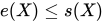
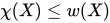
Basic inequalities


03Cardinal functions in Boolean algebras
Cardinal functions are often used in the study of Boolean algebras. We can mention, for example, the following functions:
- Cellularity
of a Boolean algebra
is the supremum of the cardinalities of antichains in
- Length
of a Boolean algebra

- Depth
of a Boolean algebra
.
- Incomparability
of a Boolean algebra
.
- Pseudo-weight
of a Boolean algebra

04Cardinal functions in algebra
Examples of cardinal functions in algebra are:
- Index of a subgroup H of G is the number of cosets.
- Dimension of a vector space V over a field K is the cardinality of any Hamel basis of V.
- More generally, for a free module M over a ring R we define rank
as the cardinality of any basis of this module.
- For a linear subspace W of a vector space V we define codimension of W (with respect to V).
- For any algebraic structure it is possible to consider the minimal cardinality of generators of the structure.
- For algebraic field extensions, algebraic degree and separable degree are often employed (the algebraic degree equals the dimension of the extension as a vector space over the smaller field).
- For non-algebraic field extensions, transcendence degree is likewise used.
Sources and credits
This article is adapted from the Wikipedia article “Cardinal function”, written by its contributors and licensed under CC BY-SA 4.0. Fathomly has changed the layout, removed citation markers, navigation and maintenance notices, and adjusted punctuation. This adapted version is shared under the same license. For references, see the original article.
Fathomly is not affiliated with or endorsed by the Wikimedia Foundation. Spotted a problem? Tell us.