Bounded deformation
In mathematics, a function of bounded deformation is a function whose distributional derivatives are not quite well-behaved-enough to qualify as functions of bounded variation, although the symmetric part of the derivative matrix does meet that condition. Thought of as deformations of elasto-plastic bodies, functions of bounded deformation play a major role in the mathematical study of materials, e.g. the Francfort-Marigo model of brittle crack evolution.
More precisely, given an open subset Ω of Rn, a function u : Ω → Rn is said to be of bounded deformation if the symmetrized gradient ε(u) of u,
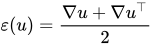
is a bounded, symmetric n × n matrix-valued Radon measure. The collection of all functions of bounded deformation is denoted BD(Ω; Rn), or simply BD, introduced essentially by P.-M. Suquet in 1978. BD is a strictly larger space than the space BV of functions of bounded variation.
One can show that if u is of bounded deformation then the measure ε(u) can be decomposed into three parts: one absolutely continuous with respect to Lebesgue measure, denoted e(u) dx; a jump part, supported on a rectifiable (n − 1)-dimensional set Ju of points where u has two different approximate limits u+ and u−, together with a normal vector νu; and a "Cantor part", which vanishes on Borel sets of finite Hn−1-measure (where Hk denotes k-dimensional Hausdorff measure).
A function u is said to be of special bounded deformation if the Cantor part of ε(u) vanishes, so that the measure can be written as

where H n−1 | Ju denotes H n−1 on the jump set Ju and 
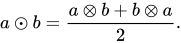
The collection of all functions of special bounded deformation is denoted SBD(Ω; Rn), or simply SBD.
Sources and credits
This article is adapted from the Wikipedia article “Bounded deformation”, written by its contributors and licensed under CC BY-SA 4.0. Fathomly has changed the layout, removed citation markers, navigation and maintenance notices, and adjusted punctuation. This adapted version is shared under the same license. For references, see the original article.
Fathomly is not affiliated with or endorsed by the Wikimedia Foundation. Spotted a problem? Tell us.